REVIEW · NEW DELHI
Golden Triangle Group Tour with 5 Star Hotels – All Inclusive
Book on Viator →Operated by Select India Holidays · Bookable on Viator
Six days, three cities, and very little wasted time.
What I like most is how the day plan mixes big icons with real street-level scenes, especially the Old Delhi electric rickshaw ride through Chandni Chowk, and then the truly unforgettable Taj Mahal time that gets real attention instead of a quick walk-by. The other big win is that a local English-speaking guide and key entrance fees are included, so you’re not scrambling last minute. One consideration: lunch and dinner are not included, so you’ll want to budget for meals (or plan what you’ll do at each stop).
This is a group tour with a maximum of 9 people, which keeps it from feeling like cattle herding. You’ll also get pickup-style transfers in and out of Delhi (starting at Indira Gandhi International Airport), plus an air-conditioned vehicle for the sightseeing legs and intercity drives, including all fuel and parking charges. If you like a clear plan but still want breathing room at major monuments, this schedule is designed for that.
In This Review
- Key highlights that matter before you go
- Golden Triangle basics: why Delhi–Agra–Jaipur is still the smart first loop
- Group comfort, pickup, and what’s really included (and what isn’t)
- Day 1 in New Delhi: landing, settling in, and getting your bearings
- Day 2 in Old Delhi: electric rickshaw, Jama Masjid, Raj Ghat, and Qutub Minar
- Chandni Chowk by electric rickshaw
- Jama Masjid: Mughal capital scale
- Raj Ghat and the solemn memorial pauses
- Viceroy’s House and Shantipath diplomatic drive
- Qutub Minar: where height becomes history
- Day 3 to Agra: a 4-hour drive with a tea stop and a first Taj moment
- Day 4 in Agra: Taj Mahal for real, plus Agra Fort
- Taj Mahal: give it two hours and actually look
- Agra Fort: the practical power of the empire
- Drive to Jaipur: 5 hours, so plan for fatigue
- Day 5 in Jaipur: Amber Fort, palace views, City Palace museums, Jantar Mantar, Birla Mandir
- Amber Fort: two hours in the thick of it
- Jal Mahal: quick photo stop with a story
- A palace for royal ladies: watch the street from inside
- City Palace: Rajput and Mughal in one complex
- Jantar Mantar: 19 instruments for measuring the sky
- Birla Mandir: a calm finish
- Day 6 back to Delhi: countryside drive and a clean exit
- Price and value: is $190 a fair deal for this kind of tour?
- Make it feel personal: small tactics that work on a group plan
- Who should book this Golden Triangle group tour
- Should you book this Golden Triangle tour?
- FAQ
- What cities does this Golden Triangle tour include?
- Are monument entrance fees included?
- Is pickup included, and where does the tour start?
- How big is the group?
- What meals are included?
- Does the schedule include Old Delhi by rickshaw?
Key highlights that matter before you go
- Small group (max 9): easier questions, less waiting, calmer pacing.
- Electric rickshaw in Old Delhi: a different way to see Chandni Chowk’s lanes and markets.
- Included monument entry fees: Qutub Minar, Taj Mahal, Agra Fort, Amber Fort, Jantar Mantar, City Palace.
- Taj Mahal from the Yamuna viewpoint: you get that first wide look before the main visit.
- Memorial stops beyond monuments: Raj Ghat, India Gate, and the diplomatic area give context.
- Air-conditioned intercity travel: the drives between Delhi, Agra, and Jaipur are long, and comfort helps.
Golden Triangle basics: why Delhi–Agra–Jaipur is still the smart first loop
The Golden Triangle works because it’s built like a single storyline: Delhi gives you Mughal-era grandeur plus modern India’s big layers, Agra delivers the famous Mughal masterpiece, and Jaipur adds Rajput craft, fort life, and palace architecture. You get this without planning separate tickets, separate guides, and separate transport between cities.
I also like that the schedule is not only monuments-on-repeat. You’re not just staring at walls. You pass through the diplomatic belt on Shantipath, stop at Raj Ghat (Gandhi’s cremation memorial), and see India’s World War I memorial, which changes the way the trip feels. It’s still sightseeing, but it’s sightseeing with context.
You can also read our reviews of more tours and experiences in New Delhi.



Group comfort, pickup, and what’s really included (and what isn’t)
This trip is set up for convenience. You’ll be met at Delhi’s airport and transferred to your hotel for two nights in New Delhi, and the same idea continues as you move between cities by private vehicle. You also get a mobile ticket and a group format, with group discounts as part of the sales pitch.
Here’s what the package clearly covers:
- Local English-speaking guide for sightseeing
- Air-conditioned vehicle for the route
- Rickshaw ride in Old Delhi
- Monument entrance fees for several key sites
- Breakfast for 5 days
And here’s the part people often assume incorrectly because of the all-inclusive wording: lunch and dinner are not included. That doesn’t make the tour bad; it just means you should plan meals in a way that matches your energy. After long monument days, I prefer having that freedom rather than being forced into one restaurant, but you still want to budget.
Day 1 in New Delhi: landing, settling in, and getting your bearings
On Day 1, you arrive and transfer straight to your hotel for two nights. That matters more than it sounds, because India trip schedules can feel intense if you spend your first hours fighting traffic and finding your own way.
I like the calm start: you’re not pushed immediately into a full-day march of sights. You’ve got a buffer to recover from the flight, and you can also get your head around the geography. Delhi is huge, and even just understanding where Old Delhi is versus the newer diplomatic and government areas can help the next day feel easier.
Day 2 in Old Delhi: electric rickshaw, Jama Masjid, Raj Ghat, and Qutub Minar
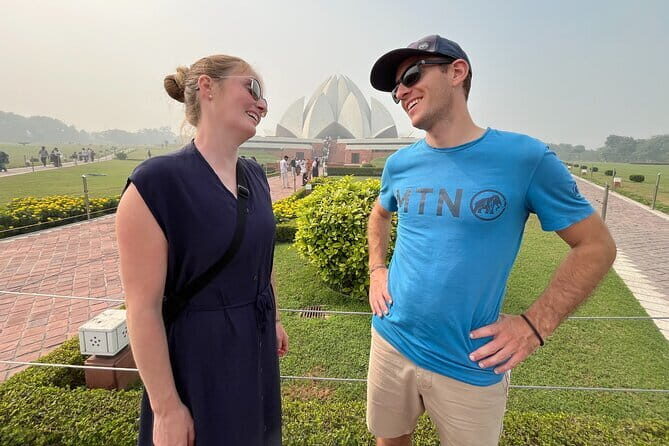
This is one of the best-balanced days because it gives you two Delhi styles in one shot: Old Delhi street life and then a jump to major monumental architecture.
Chandni Chowk by electric rickshaw
You’ll ride an electric rickshaw through Chandni Chowk, one of the oldest and busiest market areas in central north Delhi. The tour frames it as a huge wholesale market, and even if you don’t shop, it’s a strong way to see how dense the area is and how goods move through narrow lanes.
What I’d do: take photos while you can, but also pause and look at the rhythm—people, signage, and how the lanes funnel you forward. This stop is only about 30 minutes, so treat it like a quick orientation to the neighborhood.




Jama Masjid: Mughal capital scale
Next is Jama Masjid, the imperial mosque associated with Shahjahanabad, the old Mughal capital. The stop time is short, but this is still one of those sights where scale hits you fast.
If you visit with respectful clothing and a calm pace, you’ll enjoy it more than you think. It’s not just a landmark; it’s a living religious space.
Raj Ghat and the solemn memorial pauses
Then comes Raj Ghat, the memorial dedicated to Mahatma Gandhi where he was cremated, built in 1956. The schedule is only around 30 minutes, but it gives you a rare emotional reset during a sightseeing-heavy trip.
After that, the plan includes a 42-meter memorial honoring 70,000 Indian soldiers who died in World War I fighting for the British Army. Even if you know little about the story, the stop gives you a deeper lens on how colonial-era events shaped modern memory.
Viceroy’s House and Shantipath diplomatic drive
You also drive past the former Viceroy’s House, now the presidential residence (designed by Sir Edwin Lutyens and Herbert Baker). This is one of those “you’ll recognize it from photos” moments, even if you only see it from the road.
Then the vehicle heads through Shantipath, Delhi’s diplomatic area, so you get views of multiple embassies. It’s a quick drive, but it helps you understand why Delhi feels split into different zones: old and new, public and official.
Qutub Minar: where height becomes history
You finish Day 2 at Qutub Minar, a 72.5-meter minaret built in 1192 by Qutab-ud-din Aibak. The entrance ticket is included, and the time block is about 45 minutes—enough to see details without rushing.
I like ending with this because it’s visual from almost anywhere around it. It anchors your sense of time, from early sultanate architecture into what follows in Agra and Jaipur.
Day 3 to Agra: a 4-hour drive with a tea stop and a first Taj moment

After breakfast, you check out and head to Agra. The ride is about 4 hours, with a 30-minute tea/coffee break, which is exactly the kind of pause that keeps long drives from feeling miserable.
Once you arrive, you check into your hotel for the night. That overnight stop is important, because it gives you a proper evening instead of traveling straight through.
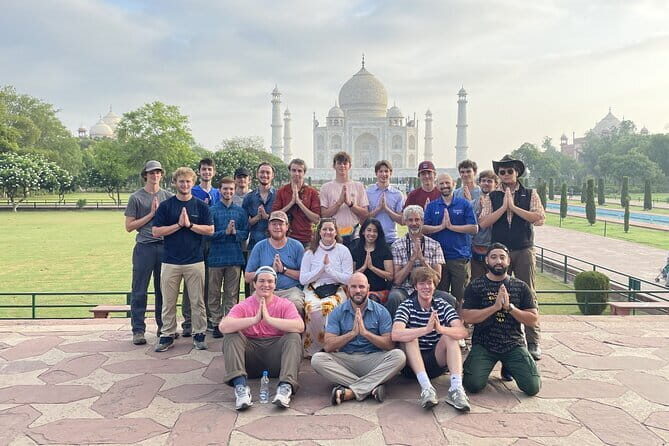
Later, you visit a Taj Mahal view point across the Yamuna River. This is a smart move. You get the wide, “wow” silhouette first, then you’ll go inside the main visit the next day. It also helps you choose where you want to focus when you see it again.
Day 4 in Agra: Taj Mahal for real, plus Agra Fort
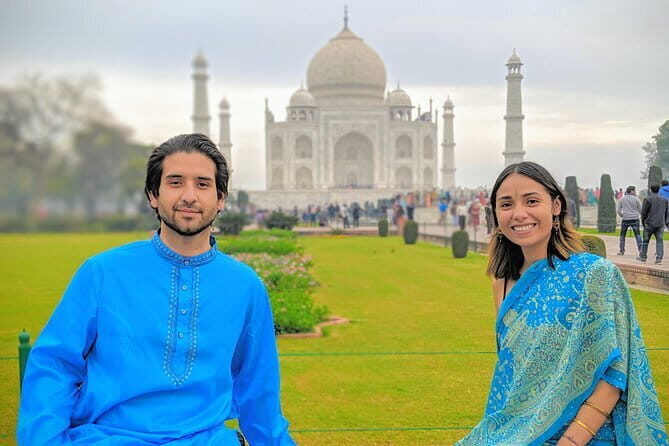
This is the day that most people come for, so it’s worth understanding how to enjoy it.
Taj Mahal: give it two hours and actually look
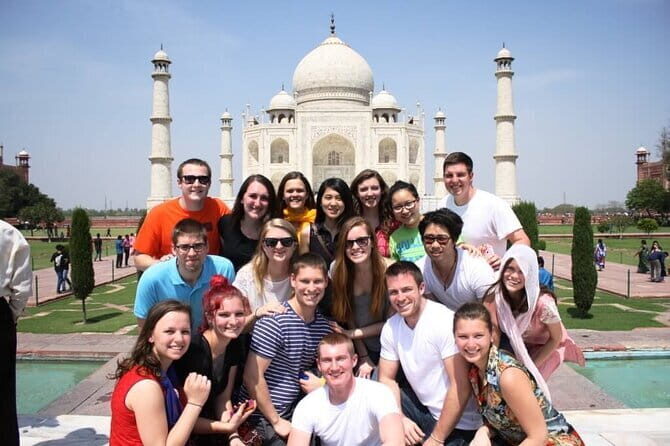
The Taj Mahal visit is timed for about 2 hours, with entrance included. The tour frames it as Shah Jehan’s monument to Mumtaj Mahal, and seeing the building with actual time is the difference between understanding and just photographing.
I recommend you do two passes with your eyes:
- First pass: take in the full layout and symmetry.
- Second pass: slow down on details—arches, stonework, and the way the complex is set up.
Two hours sounds long until you’re there. Then it becomes perfect.
Agra Fort: the practical power of the empire
Next is Agra Fort, a UNESCO World Heritage site. You get about 1 hour, and it includes the entrance fee.
This fort feels different from the Taj Mahal. The Taj is elegance; Agra Fort is military power and royal residence layers. You’ll get a sense of how the city was built around control and command.
Drive to Jaipur: 5 hours, so plan for fatigue
Afternoon brings a 5-hour journey to Jaipur, with 1 or 2 breaks for tea or coffee. This is the part where comfort matters, and the air-conditioned vehicle helps a lot.
If you’re prone to getting cranky in transit, pack something small for entertainment and try to sleep. Jaipur will be more fun if you arrive ready for forts.
Day 5 in Jaipur: Amber Fort, palace views, City Palace museums, Jantar Mantar, Birla Mandir
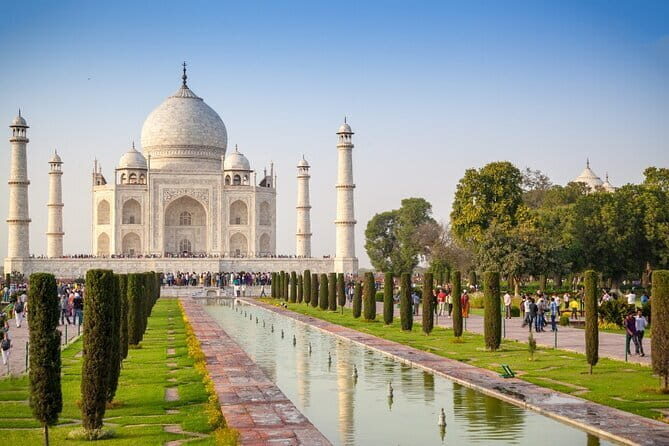
Jaipur is where the Golden Triangle tour shifts from Mughal grandeur to Rajput architecture, court culture, and astronomy-in-stone.
Amber Fort: two hours in the thick of it
You start with Amber Fort. It’s built originally by Raja Man Singh and expanded by Maharaja Jai Singh I, with changes added over the next 150 years. You get about 2 hours and entrance is included.
I like Amber Fort because it’s active. You see defensive design and royal living all in one space. If you keep your pace steady, you’ll get better photos without rushing. If you rush, you’ll miss the way the fort sits with the surrounding terrain.
Jal Mahal: quick photo stop with a story
Next is Jal Mahal, the “water palace,” with a 15-minute photo stop. The tour notes it was built in 1799 in Rajput style using pink sandstone, with a symmetrical design.
Even in just 15 minutes, you can catch the visual trick: the palace looks like it’s floating. Bring your camera settings from Taj-level brightness down a bit, since Jaipur sun can be sharp.
A palace for royal ladies: watch the street from inside
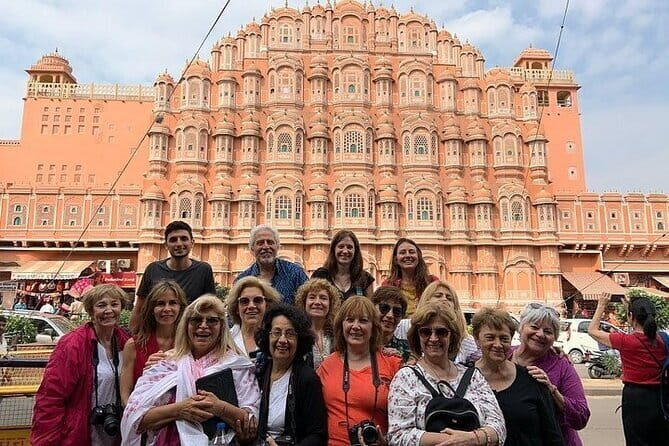
You’ll also stop at a palace described as built with pink and red sandstone as an extension of City Palace, designed for royal ladies to observe outside activities since they weren’t allowed to go out. That concept is one of the reasons Jaipur architecture feels different—you see design tied to social rules.
This is short on time, but it’s the kind of detail that makes a stop memorable. Even if you don’t know the exact legend, you understand the idea: architecture as social control.
City Palace: Rajput and Mughal in one complex
Then you move to City Palace of Jaipur, timed at about 1 hour with entry included. The tour describes a fusion of Rajputana and Mughal architecture, and notes that the royal family still lives in a private section.
The schedule points you toward several places inside, including Chandra Mahal, Mubarak Mahal, Shri Govind Dev Ji Temple, and the City Palace Museum, among others. One hour is enough to see the complex’s variety, but not enough to fully absorb every room. So focus on highlights and let the rest be background texture.
Jantar Mantar: 19 instruments for measuring the sky
After that, you go to Jantar Mantar, an astronomical observatory with 19 astronomical instruments, built by Maharaja Sawai Jai Singh II in the 18th century. Entrance is included, and the stop time is about 45 minutes.
I find this one refreshingly different because it isn’t only visual. It makes you think about how people used structures to track time, movement, and prediction long before modern tech.
Birla Mandir: a calm finish
You end with Birla Mandir, a Hindu temple dedicated to Lord Vishnu and Goddess Laxmi. The stop is about 30 minutes and the entrance is marked as free.
This is a gentler way to close Day 5 compared with forts and huge courtyards. If you want a quiet moment after a long day, this is it.
Day 6 back to Delhi: countryside drive and a clean exit

On the last day, you leave after breakfast and travel by road through the countryside back to Delhi. The drive is about 5 hours, and when you arrive, your driver transfers you to Delhi Airport or your preferred place in Delhi.
I like the “straight out and go” feeling on the final day. It keeps you from having to find your own transport at the end of the trip when you’re already tired.
Price and value: is $190 a fair deal for this kind of tour?
At about $190 for roughly 6 days, this pricing only makes sense if you’re benefiting from the package structure. And you are: the plan includes an English guide, air-conditioned transport, key monument entrance fees, a rickshaw ride, and breakfast for 5 days.
Two things can change the value for you:
- If you’re fine eating lunch and dinner on your own, the package stays strong.
- If you want the tour to cover every meal, the missing lunches and dinners can add cost quickly.
Also, group size matters. With a maximum of 9 people, you’re getting the “group tour price” without the worst parts of big-group logistics.
If you want a trip where the heavy lifting is handled—tickets, entry fees, and transport—this price can be a bargain.
Make it feel personal: small tactics that work on a group plan
Even in a group, you can control your experience.
- Ask at the start: confirm where the guide wants you to line up first and when to re-group.
- Choose your slow moments: you’ll have time blocks like 2 hours at Taj Mahal and 2 hours at Amber Fort—use those to slow down, not to rush to every photo angle.
- Wear comfortable shoes: forts and monument grounds often require more standing and walking than you expect.
- Plan your meals strategically: since lunch and dinner aren’t included, I suggest you eat early on heavy-sightseeing days and save time for water breaks.
If you coordinate with the company side, there’s a pattern in how people describe the experience as smooth and stress-free, including support from a planner named Mr. Om Prakash for hotel and car arrangements. That kind of responsiveness can matter on the days when schedules shift or you need quick answers.
Who should book this Golden Triangle group tour
This tour fits best if you want:
- A first-time Golden Triangle trip with a guided plan
- Comfortable shared transport and included entrance fees for major sights
- A small group setting (max 9) rather than a huge bus crowd
- A schedule that gives you meaningful time at major monuments like Taj Mahal and Amber Fort
If you’re the type who hates being on any timetable, or you want total flexibility for meals, photography, and repeat visits, you might find a group plan limiting. In that case, private day-by-day planning could suit you better.
Should you book this Golden Triangle tour?
Yes, I’d seriously consider it if you want a structured, comfortable introduction to Delhi, Agra, and Jaipur—with the key tickets handled and a guide to explain what you’re seeing.
Skip it if you know you’ll want lunch and dinner handled by the tour at all times, or if you prefer sleeping schedules and sight order that change every day. For most people trying to do the Golden Triangle without headaches, this is a solid value way to get the big moments plus a few thoughtful stops that add meaning.
FAQ
What cities does this Golden Triangle tour include?
It covers New Delhi, Agra, and Jaipur, traveling between the three cities over about 6 days.
Are monument entrance fees included?
Yes. Entrance fees are included for Qutub Minar, Taj Mahal, Agra Fort, Amber Fort, Jantar Mantar (Jaipur), and City Palace of Jaipur.
Is pickup included, and where does the tour start?
You’ll have arrival and departure by private vehicle, and the start point listed is Indira Gandhi International Airport, New Delhi.
How big is the group?
The maximum group size is 9 travelers.
What meals are included?
Breakfast is included for 5 days. Lunch and dinner are not included.
Does the schedule include Old Delhi by rickshaw?
Yes. You’ll do a rickshaw ride in Old Delhi, described as an electric rickshaw during the Chandni Chowk visit.