REVIEW · NEW DELHI
go Tajmahal tours
Book on Viator →Operated by Inde Decouverte · Bookable on Viator
A day trip to Agra can feel like a rush—this one helps. You get a private car, a professional driver, and a certified guide who brings the sites to life while you move between UNESCO landmarks. I love that entrance fees are included and tickets are handled for you, so you’re not wasting time at counters. The main thing to consider is it’s a long day (12 hours), so build in a relaxed pace and comfortable shoes.
You’ll also like the “control” factor: pickup is offered, you get WiFi on board and bottled water, and the schedule is built around major sights rather than random stops. The only drawback is lunch isn’t included, so plan to either grab something before you start or be ready to buy along the way.
If you want a guided Agra day that feels organized and not stressful, this fits well. Just remember you’ll be walking through some busy areas and spending real time outdoors at the Taj Mahal.
In This Review
- Key things that make this tour worth your time
- Private car from New Delhi: the real value is stress-free timing
- Taj Mahal: what you should actually look for in your 2-hour visit
- Walk the building sequence, not just the postcard views
- Use the timing advantage
- The guide’s role at the Taj Mahal
- Agra Fort: why the Red Fort next door feels different
- How much time you get—and what that means
- Itimad-ud-Daulah (Baby Taj): the “why didn’t I know this earlier?” stop
- Why this stop is worth your hour
- Mehtab Bagh: the quieter Taj view that’s worth the extra effort
- What to do with your 1 hour
- What’s included (and how it affects your budget)
- Who this tour is best for
- Small practical notes that keep the day smooth
- Should you book go Tajmahal tours?
- FAQ
- What time does the tour start?
- Where is the meeting point?
- What is the total duration of the experience?
- Is pickup included?
- Are entrance fees for the monuments included?
- Do I need lunch planning?
- What does the tour include for comfort during the drive?
- What happens if weather is poor?
Key things that make this tour worth your time
- Early start, calmer Taj Mahal visit: the 8:30am pickup time helps you see the Taj Mahal before the day gets hectic.
- Tickets handled in advance: mobile ticketing plus included monument fees means less time stuck in lines.
- Real guided context: a complimentary certified guide explains what you’re looking at, not just where to stand for photos.
- Four UNESCO stops, well spaced: Taj Mahal, Agra Fort, Itimad-ud-Daulah (Baby Taj), and Mehtab Bagh in one day.
- Comfort perks for the road: private transport with WiFi and bottled water.
- Common guide types you may be assigned: names like Furkan (noted for French), Raju, and Nadir Hussein show up in guidance examples, depending on your language.
Private car from New Delhi: the real value is stress-free timing
This is a one-day run from New Delhi with a professional driver in a high-standard private car. That matters more than it sounds. In practice, the hardest part of a Taj Mahal day trip isn’t seeing the monuments—it’s getting from point A to B without losing your morning (or your patience) to traffic and ticket hassles.
You’ll start at 8:30am from Starbucks, Shop No 16, Connaught Cir, Block N, Connaught Place. The tour runs about 12 hours, and it includes travel time, so you aren’t trying to puzzle out an extra transfer after the fact. The tour also includes WiFi on board and bottled water, small comforts that add up on a long day.
Where the experience is strongest is that you’re not left to coordinate entry details yourself. The tour includes all monument entrance fees, plus mobile tickets. That means you can spend your energy on the sights instead of getting stuck in admin moments.
Practical tip: pack light but bring what you’ll need for a big walking day—especially water for outside time and something for sun shade.
You can also read our reviews of more tours and experiences in New Delhi.



Taj Mahal: what you should actually look for in your 2-hour visit
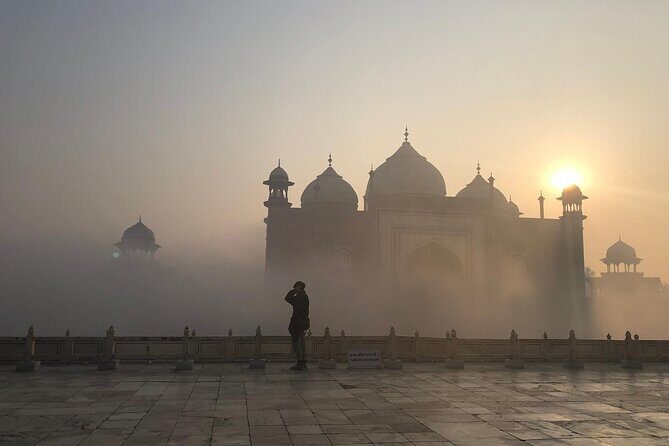
The Taj Mahal is the headliner for a reason. It’s an ivory-white marble mausoleum commissioned in 1631 by Mughal emperor Shah Jahan to house the tomb of his wife Mumtaz Mahal. Construction was essentially complete by 1643, and the whole complex sits on the right bank of the Yamuna in a formal garden layout.
Here’s how to make your 2 hours count.
Walk the building sequence, not just the postcard views
Start by letting the scale hit you. The Taj is the centerpiece of a complex of about 17 hectares (42 acres), bounded by a crenelated wall and organized with gardens plus key structures like the mosque and guest house. You’ll see why people call it the jewel of Mughal art—its beauty isn’t just the white marble. It’s the way the architecture and landscaping work as a single composition.
Then look for the details that show it’s a Mughal masterpiece. The Taj Mahal is widely regarded as the best example of Mughal architecture, and visitors who spend a few quiet minutes observing the proportions usually enjoy it more than those who only chase wide shots.
Use the timing advantage
One reason this tour works is the schedule. With an 8:30am start, you’re set up for a quieter experience compared to later entry waves. That’s when your visit turns from crowded scramble to actual viewing. If you’re sensitive to crowds, that early arrival is the difference between irritation and enjoyment.
The guide’s role at the Taj Mahal
A certified guide included on the tour is one of the biggest practical boosts. You’re not only shown where to go—you’re given context: the mausoleum’s purpose, the Mughal story, and how the complex is laid out. In past language support examples, guides such as Furkan (noted for speaking French) have been highlighted for explaining history and architecture clearly.





Agra Fort: why the Red Fort next door feels different

Most people think of Agra and immediately picture the Taj. But Agra Fort is the counterweight: heavy, defensive, and full of power.
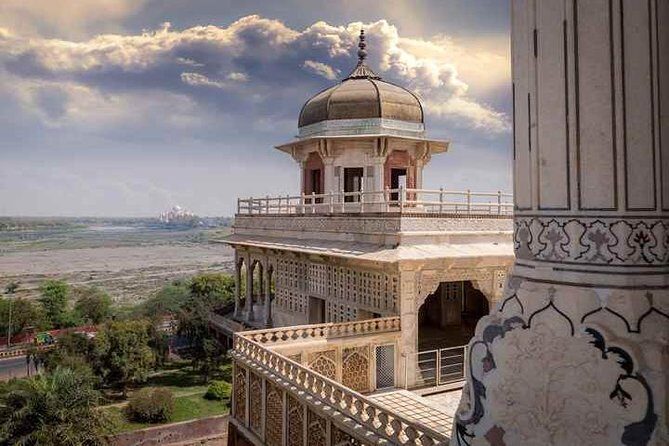
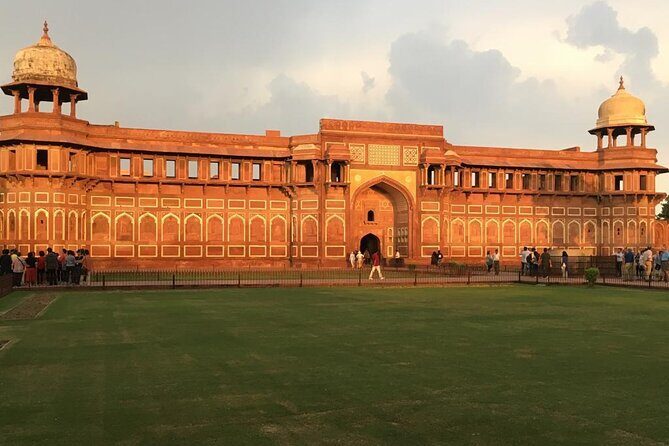
Agra Fort is also called Lal-Qila (Red Fort) and is a historical fort within Agra. The Mughal emperor Akbar rebuilt it starting in 1565 and it was completed in 1573. It served as the main residence for Mughal rulers until the capital shifted from Agra to Delhi in 1638.
What I like about pairing it with the Taj Mahal is the contrast. The Taj is graceful marble and garden geometry. Agra Fort is a walled city feeling—more structure, more history, more “this is where decisions were made.”
How much time you get—and what that means
You’ll spend about 1 hour at Agra Fort. That’s not enough to read every inscription or tour every corner like a historian—but it’s enough to understand the fort’s scale and why it mattered. Aim to focus on key viewpoints and the fort’s overall layout rather than trying to see everything.
Also, remember the location: it’s about 2.5 km northwest of the Taj Mahal. So you’re not far from the main monument even when you switch to a different vibe.
Itimad-ud-Daulah (Baby Taj): the “why didn’t I know this earlier?” stop
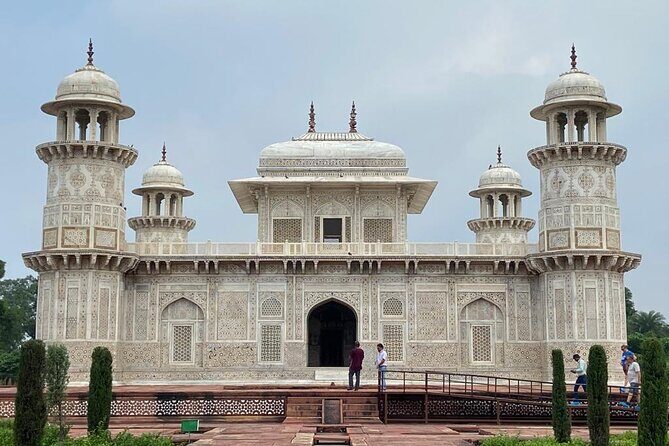
If the Taj Mahal is the star, Itimad-ud-Daulah’s tomb is the understudy that steals scenes. It’s often called the Baby Taj and is described as a “jewel box.” It’s also sometimes viewed as a draft or prototype of the Taj Mahal.
The tomb is a Mughal mausoleum in Agra, built between 1622 and 1628. Its design reflects a transition in Mughal architecture: shifting from the earlier phase that relied more on red sandstone with marble decorations (like Humayun’s Tomb in Delhi and Akbar’s tomb in Sikandra) toward the later phase that used white marble and pietra dura inlay more prominently—something most famously achieved at the Taj Mahal.
Why this stop is worth your hour
You get 1 hour here, including admission. For me, the payoff is learning the “development story.” When you move from the Taj to this tomb, you can see how Mughal monumental design evolved rather than treating everything as one static masterpiece.
If your guide is strong, this is the moment they can really add value—explaining what architectural shift means in plain language, and pointing out the kinds of details you’d otherwise miss.
Mehtab Bagh: the quieter Taj view that’s worth the extra effort
Mehtab Bagh is a Mughal garden opposite the Taj Mahal and the Agra Fort across the Yamuna. It’s the last of eleven Mughal-built gardens along the riverfront, and it’s tied to the Mughal tradition of designing garden spaces as part of the monument experience.
This garden was built by Emperor Babur (d. 1530). Shah Jahan also identified the opposite river site as ideal for viewing the Taj Mahal. The garden was created as a moonlit pleasure garden with walkways, pavilions, pools, and fountains—plus fruit trees and narcissus.
What to do with your 1 hour
You get about 1 hour at Mehtab Bagh. I’d treat this like your decompression stop. Instead of racing for “the next thing,” slow down and take in the composition from across the river.
You’re not just looking at the Taj—you’re looking at how Mughal planners framed it as a distant, reflected, and constantly shifting vision. If your goal is photos, you’ll likely find angles here that feel different from the main viewing area. If your goal is understanding, this is where the symbolism lands.
What’s included (and how it affects your budget)
This trip is priced at $147.80 per person for a 12-hour private day tour. Here’s the value angle: you’re paying for more than a car. You’re paying for time saved, plus the costs that usually add up on a DIY version—especially entrance fees to major sites.
Included items:
- Private transportation
- WiFi on board
- Bottled water
- All monument entrance fees
- A certified guide who travels with you along the way
- Pickup offered
- Mobile ticket
Not included:
- Lunch
- Alcoholic beverages
That “not included” lunch point is the one budget surprise. If you usually travel with a set plan, decide in advance how you’ll handle meals. If you’re flexible, you can treat lunch as part of the day’s local flavor—just don’t let it become an unplanned delay.
Who this tour is best for
This fits best if you:
- Want the Taj Mahal plus major Agra sights in a single day without logistics headaches.
- Prefer a guide over self-guiding through big monuments.
- Are traveling with family or a mixed-age group and want pacing that stays manageable.
It may be less ideal if you:
- Plan to spend hours per site. The schedule is efficient, not slow.
- Are someone who loves deep independent wandering. This tour keeps you moving with purpose.
Small practical notes that keep the day smooth
- Comfort matters: 12 hours is long. Wear shoes you can walk in for multiple stops.
- Sun and weather: this experience requires good weather. If the tour is canceled due to poor weather, you’ll be offered a different date or a full refund.
- Ticket stress stays low: mobile ticketing plus included fees helps you avoid awkward ticket-counter detours.
- Language support can be strong: multiple language guide support is part of the concept, and examples include French-speaking guides such as Furkan.
Should you book go Tajmahal tours?
I’d book it if your priority is a smooth, guided Agra day that hits the big UNESCO monuments without making you fight for tickets or figure out timing on your own. The combination of private transport, included entrance fees, and a certified guide is the core reason this feels worth the money.
If your main goal is slow, unscheduled exploration, then you might prefer a more flexible plan. But for many visitors—especially first-timers—this is a strong way to get the Taj Mahal experience with less friction and more meaning.
FAQ
What time does the tour start?
The tour starts at 8:30am.
Where is the meeting point?
The meeting point is Starbucks, Shop No 16, Connaught Cir, Block N, Connaught Place, New Delhi, Delhi 110001.
What is the total duration of the experience?
The tour duration is about 12 hours (including travel time).
Is pickup included?
Yes. Pickup is offered as part of the tour.
Are entrance fees for the monuments included?
Yes. All monument entrance fees are included, and tickets are handled as mobile tickets.
Do I need lunch planning?
Lunch is not included, so you should plan your meal during the day or buy food separately.
What does the tour include for comfort during the drive?
You get WiFi on board and bottled water with the private transportation.
What happens if weather is poor?
This experience requires good weather. If it’s canceled due to poor weather, you’ll be offered a different date or a full refund.