A trip through Jaipur can feel like organized chaos—until you have a plan. This private full-day Jaipur tour lines up the big-name sights—Amer, City Palace, Jantar Mantar, plus quick photo stops—so you spend less time figuring out logistics and more time looking up at the architecture. I like that it’s built around a realistic 8-hour rhythm with hotel pickup and drop-off in an air-conditioned vehicle. One heads-up: entrance fees (and possible camera fees) aren’t included, so you’ll want to budget a bit extra beyond the tour price.
What makes it especially worth your attention is the guide factor. In the feedback, guides named Mehraj, Madan Singh, Rajesh, and Vivek show up again and again for the same reason: they keep things calm, explain what you’re seeing in plain terms, and help with the day’s practical details. Another plus is that one contact person, Kamal, was even able to help when a health issue popped up, which tells me this crew can handle more than just sightseeing.
Value-wise, the pricing is straightforward—$60 per person for a full-day private format, with AC transport and all fuel/parking/tolls handled. But the schedule includes several short stops (like Hawa Mahal and Jal Mahal), so if you want long time for wandering on your own, you’ll need to treat this as a guided orientation day and add extra hours separately.
In This Review
- Key highlights if you want the short version
- A private Jaipur day that actually feels doable
- Hawa Mahal in 15 minutes: what to expect and how to use it
- Amer Fort: the 3-hour heart of the day
- Jal Mahal’s lake pause at Man Sagar
- City Palace: 2 hours in a living complex
- Jantar Mantar: 1734 instruments for curious minds
- Afternoon shopping in Pink City: how to shop without getting tired
- Price and logistics: why $60 can be good value
- Guide support is the real differentiator here
- Timing, weather, and pacing the 8 hours
- Should you book this private Jaipur full-day tour?
- FAQ
- What sites are included in the full-day Jaipur route?
- How long is the tour, and is it private?
- Is hotel pickup and drop-off included?
- Are entrance fees included for the monuments?
- What is the price for the tour?
- Is there shopping included?
- Can the tour be refunded if the weather is bad?
Key highlights if you want the short version
- Air-conditioned private transport with hotel/rail/bus pickup and drop-off
- A focused route: Hawa Mahal, Amer, Jal Mahal, City Palace, and Jantar Mantar
- Good time allocation: 3 hours at Amer, 2 hours at City Palace, 1 hour at Jantar Mantar
- Shopping window in the afternoon with a guide who can steer you through local crafts
- Proactive guide support, including help with on-the-ground logistics (seen in guide feedback)
- Entrance fees not included, so you control what you pay for at each site
A private Jaipur day that actually feels doable
Jaipur is popular for a reason, but it’s also busy. The best part of this tour is that it removes the daily friction: you get pickup and drop-off and a driver/guide setup that keeps you moving between sights without the usual hassle. The vehicle is air-conditioned, which matters when your day starts in the morning and keeps going.
The route is designed like a checklist, but with smart timing. You get one long anchor stop (Amer), two solid middle stops (City Palace and Jantar Mantar), and two shorter “look and photograph” moments (Hawa Mahal and Jal Mahal). That mix works well if you want the headline sights without spending the whole day stuck in slow transitions.
Also, this is set up as private for your group, not a mixed scramble with strangers. That typically makes timing and pacing feel smoother, especially if you have questions or want a bit more time at one stop.
You can also read our reviews of more guided tours in Jaipur


Hawa Mahal in 15 minutes: what to expect and how to use it
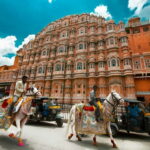
Hawa Mahal (Palace of Wind) is one of Jaipur’s most recognizable façades. In this tour, it’s scheduled for about 15 minutes, and the tour notes admission tickets are not included for this stop. So this isn’t a “slow, detailed walkthrough” stop. It’s the stop where you get your bearings fast and capture the look.
Here’s how to make the most of that short window. First, decide what you want: the famous exterior and its honeycomb-like look, or any interior access if you choose to pay on-site. Second, be ready to move on quickly. A 15-minute slot means you’ll likely do photos plus a quick explanation, not a long visit.
If you’re coming in with an instinct to linger at doorways and carvings, you’ll have to satisfy that urge elsewhere. The trade-off is that you’ll save time for Amer, where you truly get breathing room.
Amer Fort: the 3-hour heart of the day
Amer is the big time investment at about 3 hours, and the tour details list admission ticket as free for this stop. That makes it a great anchor point in the itinerary: you’re not only getting a major sight, you’re also spending the most hours here, which is usually how you learn the place.
Amer is described as a blend of Hindu and Muslim architecture, built from red sand. That blend matters because it changes what you notice as you move around. Instead of seeing only one style, you start picking out overlaps—patterns, proportions, and design choices that don’t belong to just one tradition. It’s the kind of place where a guide’s narration can help you see what you’d otherwise miss.
This is also the most likely spot where you’ll want to pause for questions: Why the design looks the way it does, how the complex was organized, and what you should pay attention to as you keep walking. With 3 hours, you can do that without feeling rushed.
Practical note: a day built around Amer plus palace complexes means you’ll do a fair amount of moving on-site. Wear comfortable shoes and plan for sun or shade. If the weather is harsh, go for quick photo stops when you need them and slow down where you can.
Jal Mahal’s lake pause at Man Sagar
Jal Mahal sits on Man Sagar Lake, and the tour gives it about 15 minutes. Admission isn’t included for this stop, which reinforces the idea: treat Jal Mahal as a snapshot and a story stop, not a long activity.
What makes it fun is the contrast. You’re moving from fort architecture to palace architecture, and then you hit this image of a palace-like structure meeting the water. Even if you only get a short look, it breaks up the day visually and gives you a memorable photo moment.
Because the time is short, keep your expectations realistic. If you want a prolonged scenic walk or a long stay for photos, this schedule won’t be built for that. Instead, it’s a good “check it off” moment that keeps your energy for the longer, indoor-leaning sites later.
City Palace: 2 hours in a living complex
City Palace gets about 2 hours, and admission isn’t included according to the tour notes. This is one of the strongest parts of the day because it’s described as a fusion of Mughal and Rajput architecture, and it’s still in use as a palace complex. That “still active” feel is the difference between seeing a museum and seeing a place that remains part of life.
When you’re there for two hours, you can do a steady walk without sprinting. You’ll get time to look closely at how rooms connect, how the design shifts across areas, and how the palace layout supports the story of Jaipur’s royal past.
The guide helps here, mainly because palace complexes can feel like a lot of rooms and angles if you don’t know what you’re looking for. You’ll likely get better from this stop if you ask for a simple plan: start with what’s most important, then fill in the smaller details at a comfortable pace.
You can also read our reviews of more private tours in Jaipur






Jantar Mantar: 1734 instruments for curious minds
Jantar Mantar is scheduled for about 1 hour, and admission isn’t included. It’s a collection of 19 astronomical instruments built by the Rajput king Sawai Jai Singh II and completed in 1734—and that date gives the site a useful sense of scale. This is science built into stone, not a modern exhibit.
One reason I think this stop works for most people: it feels different from the palace-and-fort rhythm. You’re standing in an open space with big shapes and thinking tools. A good guide can connect the instrument forms to how they were used to measure things in the sky.
With just an hour, don’t expect to read every explanation. Use the time to understand the basic purpose, then pick one or two instruments to focus on. You’ll walk away with at least a few “oh, that’s what it’s for” moments, which is exactly what you want from a one-hour stop.
Afternoon shopping in Pink City: how to shop without getting tired
The tour includes an afternoon of shopping in Jaipur. The details list categories like silver jewelry, gems stones, blue pottery, textiles, bangles, block printings, clothes, leather goods, and handicrafts.
This is one of those parts where a guide can genuinely change your experience. If you’re shopping, you’ll appreciate help comparing items and avoiding the classic time sink of wandering into the wrong shops for your budget. With a planned shopping window, you’re also less likely to end up tired and impulsive.
Still, shopping takes energy. You’ll want to keep a loose strategy:
- Decide what you actually want to buy before you start negotiating.
- Keep your budget range in mind, especially for silver and gemstone items.
- Ask about materials and how items are made, especially for pottery, block printing, and textiles.
Because meals aren’t included, you’ll also want to make sure you don’t lose momentum. If you’re hungry during shopping, it can turn decision-making into a blur.
Price and logistics: why $60 can be good value
At $60 per person for an approximately 8-hour private tour, the value comes from what’s included. You’re getting hotel/rail/bus pickup and drop-off, a professional guide, and air-conditioned private transport. The tour also lists fuel, parking, and tolls as included, which matters because those costs can quietly add up when you hire services separately.
Where the cost logic changes is entrances. The tour notes that monuments entrance fees and camera fees aren’t included. It also lists meals and personal expenses as not included, and it flags tips for the driver/guide as not included. So think of the $60 as paying for guided movement and structure, while the site access fees are an add-on you handle case by case.
In practical terms: if you plan to enter most sites, you should budget for tickets. If you’re comfortable with a photo-focused experience at stops that are short, you may keep extra spending under control.
Guide support is the real differentiator here
The strongest praise in the provided feedback isn’t about fancy vehicles or dramatic promises. It’s about people—guides who were kind, patient, and helpful, and who made the day feel safe and organized.
Specific names you’ll see tied to great service include Mehraj (mentioned as knowledgeable, gentle, and a delightful person), Madan Singh (kind, humble, patient, and connected with local contacts), Rajesh (helped explore the city and took care of key logistics), and Vivek (point of contact who helped arrange logistics, tickets, food, and accommodation during a longer package). Another name, Kamal, is credited with solving a health problem, which is a big deal.
That matters because Jaipur isn’t just sightseeing. It’s crowds, heat, walking, and decision-making. A guide who knows how to work with local conditions can make the difference between a day that feels smooth and one that feels like you’re constantly catching up.
Timing, weather, and pacing the 8 hours
The tour notes two conditions that affect your day: it requires good weather, and it can be canceled due to poor weather with a different date or a full refund offered. It also notes a minimum number of travelers, meaning some dates might depend on demand.
On your end, treat this as a full day with a packed rhythm. Hawa Mahal and Jal Mahal are both short stops, so you’ll feel the momentum shift from quick sights to longer visits at Amer and City Palace. Plan to stay flexible. If you want extra time anywhere, this format may not be built for long detours, but your guide can often help you manage priorities.
Also, since meals aren’t included, you’ll want a simple plan: know where you can grab food near your shopping window, or bring snacks if that suits your style. When you run out of time and hunger hits, everyone’s experience gets worse.
Should you book this private Jaipur full-day tour?
Book it if you want a structured, private day that covers Jaipur’s most famous sights without you juggling transit and ticketing on your own. It’s a strong fit if you like having a guide explain what you’re seeing and you’re okay paying entrance fees separately. The route makes sense: Amer gets the time, City Palace is built in for a real visit, and Jantar Mantar adds a different kind of interest.
Skip (or modify) it if you want lots of free time to wander slowly, because the schedule includes multiple brief stops and ends up feeling like a guided route rather than an open-ended roam. Also, if you strongly prefer included meals, this one won’t meet that preference.
If your goal is to get a high-quality overview of Jaipur’s key attractions in one day—then add extra time later for the places you loved—that’s exactly the kind of traveler fit this tour seems built for.
FAQ
What sites are included in the full-day Jaipur route?
The tour covers Hawa Mahal, Amer, Jal Mahal, City Palace, and Jantar Mantar.
How long is the tour, and is it private?
It runs for about 8 hours and is private, meaning only your group participates.
Is hotel pickup and drop-off included?
Yes. You get pickup and drop-off from the hotel (and also from railway/bus stations) using an AC car.
Are entrance fees included for the monuments?
No. Monuments entrance fees and camera fees are listed as not included. One stop, Amer, is marked as admission ticket free in the tour details.
What is the price for the tour?
The price is $60 per person.
Is there shopping included?
Yes, there’s an afternoon shopping period in Jaipur, with items such as silver jewelry, gems stones, blue pottery, textiles, bangles, block printings, clothes, leather goods, and handicrafts listed.
Can the tour be refunded if the weather is bad?
The tour requires good weather. If it’s canceled due to poor weather, you’ll be offered a different date or a full refund.