REVIEW · NEW DELHI
Delhi Temple Tour
Book on Viator →Operated by Freedom Journey India · Bookable on Viator
Religion in Delhi feels close-up. This private Delhi temples tour strings together Hindu, Sikh, and Sufi sites in one day, with the kind of on-the-ground commentary that helps the different traditions click fast. You’ll start at Nigambodh Ghat on the Yamuna, then move to the Birla Laxmi Narayan Temple, the big Hanuman stop, Bangla Sahib Gurudwara lunch, Hazrat Nizamuddin Dargah, and finish with Akshardham and a famous stepwell.
I love two things in particular: first, the logistics are handled with pickup support, an air-conditioned vehicle, bottled water, and a route that keeps you moving without feeling rushed from stop to stop. Second, the guide experience matters. Pastor Vijay Kumar Sharma, often referred to as Vijay or VJ, tells the story with personal faith and practical answers, which makes the day feel like a guided orientation to Delhi spirituality—not just a checklist.
One thing to plan for: some major admissions are not included, especially for Swaminarayan Akshardham and Agrasen Ki Baoli, so you may want to budget extra. Also, parts of the day involve walking and getting in and out frequently, so comfortable shoes help.
In This Review
- Key things to know before you go
- Why this Delhi temples tour fits first-day Delhi perfectly
- Price and value: where your money goes
- Pickup, vehicle comfort, and how the day is paced
- Stop-by-stop: what you’ll see and what it feels like
- Nigambodh Ghat on the Yamuna, then the gondola crossing
- Birla Mandir (Shri Laxmi Narayan Temple): a famous Hindu temple close to the everyday
- Hanuman Mandir: a 108-ft statue and the mouth-door detail
- Gurudwara Bangla Sahib: lunch at a Sikh center of community
- Hazrat Nizamuddin Dargah: Sufi shrine energy in winding alleys
- Swaminarayan Akshardham: big scale, longer time, and admission not included
- Agrasen Ki Baoli (stepwell): a historical 60 by 15 meters photo moment
- What the guide adds (and why it can make or break the day)
- Practical tips for making the most of an 8-hour route
- Who this tour suits best
- Should you book this Delhi temple tour?
- FAQ
- How long is the Delhi Temple Tour?
- Is this a private tour?
- What’s included in the price?
- Is lunch included?
- Are temple admission tickets included?
- What happens if the weather is bad?
Key things to know before you go
- A one-day mix of Hindu, Sikh, and Sufi holy places with short, focused time at each stop
- Private car + driver using the right vehicle size for your group (Dzire for 1–3, Innova/Ertiga for 4–5, Tempo Traveler for larger groups)
- Free entry at most stops, then two notable sites where admission isn’t included
- Bangla Sahib Gurudwara lunch option that centers on vegetarian community food
- A guide-led route with live explanations, including Q&A and context across the sites
- Good weather matters, since the tour requires it and can be rescheduled or refunded if weather turns
Why this Delhi temples tour fits first-day Delhi perfectly
If you’re arriving in New Delhi and want your bearings fast, this tour is built for that. You get a tight sequence of landmarks tied to different faiths, along with commentary that explains what you’re seeing and why it matters locally. It’s especially useful when you don’t yet know the difference between ritual purpose, temple layout, and the everyday rhythm of worship.
The pace is also smart for most people. Each stop is long enough to look around, pause for photos, and understand what’s going on, but not so long that you lose the plot. In about a full day, you cover multiple districts and big spiritual sites without the stress of navigating alone.
At $21.90 per person, the value comes from what’s wrapped in. Many stops have admission listed as free, and you’re paying for a private vehicle, bottled water, and a guide who connects the dots. You’re not buying your way into one attraction; you’re buying a guided education across several.
You can also read our reviews of more tours and experiences in New Delhi.



Price and value: where your money goes
Let’s talk value in plain terms. You’re paying for a private full-day format, so you’re not stuck with random pacing or strangers’ preferences. You also get air-conditioned transport, tolls and parking handled, and bottled water included.
Most admissions on the day are free, including Nigambodh Ghat, Shri Laxmi Narayan Temple (Birla Mandir), Shri Hanuman Mandir, Gurudwara Bangla Sahib, and Hazrat Nizamuddin Dargah. The two places where you may pay separately are Swaminarayan Akshardham and Agrasen Ki Baoli, so your final spend might be higher than the headline price.
That makes the tour a strong deal if you’re happy with structured time. If you want to linger for hours at one site or build a slow, unplanned day, a tight itinerary may feel limiting. But if you want an efficient spiritual sampler with real explanations, this setup is hard to beat.
Pickup, vehicle comfort, and how the day is paced
You’re picked up from your hotel or Delhi Airport, and the driver and tour guide help you with the flow of the day. That matters more than it sounds, because Delhi traffic and timing can turn even a good plan into a headache. The route is designed so you keep moving, with a full-day feel but stops that stay focused.
Group size determines the vehicle: a Dzire for 1–3 people, Innova or Ertiga for 4–5, and Tempo Traveler options for larger groups. That usually translates to a smoother ride and enough space for everyone to stretch a bit between stops.
Expect frequent transitions. The day runs about 8 hours, with start around 9 AM and time blocks at each attraction. The route also includes walking through narrow alleys later in the day, so it’s a good idea to think in terms of shoes and a water-friendly mindset, not just photos.
Stop-by-stop: what you’ll see and what it feels like
Nigambodh Ghat on the Yamuna, then the gondola crossing
Your morning starts at Nigambodh Ghat, a Hindu cremation ground on the banks of the Yamuna River. This isn’t sightseeing in the casual sense. It’s a place where you witness one of the most important rites in Hindu life, and the setting—riverfront ghats and the flow of activity—helps you understand why this spot holds meaning.
One of the route’s key moments is crossing the river by gondola to overlook the ghats. That short ride gives you a better perspective on how the riverfront works as a whole—steps, activity zones, and the river as a living backdrop. You’ll have about 30 minutes here, and admission is free.
A consideration here: this stop can be emotionally intense. If you’re sensitive to death-related rituals, give yourself permission to observe quietly and take breaks when needed. A guide’s framing helps, but it’s still a powerful location.





Birla Mandir (Shri Laxmi Narayan Temple): a famous Hindu temple close to the everyday
After the river, you head to Shri Laxmi Narayan Temple, also known as Birla Mandir. It’s a very famous Hindu temple, and you’ll spend about 40 minutes exploring.
This stop works well after Nigambodh Ghat because it shifts the mood from ritual at the riverbank to devotional temple space. You’ll see the classic rhythm of worship—people offering prayers and moving through the temple area with purpose—while also getting context from your guide on what different icon and ritual elements are meant to communicate.
Admission here is listed as free. The downside is timing: because the day is packed, you may not be able to linger as long as you might in a temple you love. But for most first-timers, that tradeoff is worth it to keep the whole spiritual sweep balanced.
Hanuman Mandir: a 108-ft statue and the mouth-door detail
Next up is Shri Hanuman Mandir, known as one of Delhi’s most popular Hindu temple visits. The highlight is the 108 ft Lord Hanuman statue, plus a striking architectural feature described as the entrance door of the mouth.
You’ll have about 30 minutes here, with free admission. This is the kind of stop where the visuals grab you first, then the guide’s explanation helps you connect symbolism to devotion. Hanuman’s theme in Hindu tradition—strength, protection, devotion—lands more clearly when you understand the cultural logic behind why people gather at this site.
A practical note: because this is a major draw, you’ll want to keep an eye on timing so you don’t get trapped in slow-moving crowds. The tour format helps, but it’s still a busy Delhi temple.
Gurudwara Bangla Sahib: lunch at a Sikh center of community
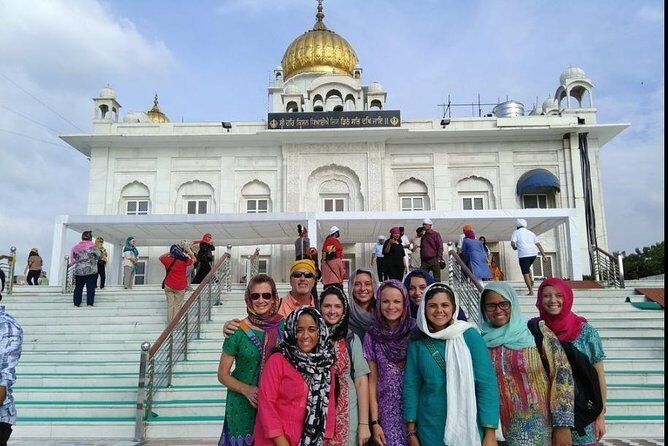
Then you’ll visit Gurudwara Bangla Sahib, an enormous Sikh place of worship. Expect a warm, communal atmosphere that contrasts with the temple and dargah settings earlier in the day.
Your schedule includes about 40 minutes here, and the best part for many people is lunch. The tour includes time for eating at Bangla Sahib, where there’s delicious vegetarian food available. The details given are simple: free food is optional, and if you choose not to eat there, you can have lunch in a restaurant at your own cost.
This stop is valuable because it shows faith as daily community life, not just a building. If you take the free meal, you’ll see how shared food works as part of the religious experience.
A consideration: vegetarian food and community dining can be popular, so lines or busy spaces might happen. Go with a patient mindset and treat it like part of the story, not an obstacle.
Hazrat Nizamuddin Dargah: Sufi shrine energy in winding alleys
After lunch, the tour shifts again. You’ll follow winding alleys to Hazrat Nizamuddin Aulia, a famous Sufi shrine. You’ll spend about 30 minutes here, with free admission.
This is where Delhi feels more like a lived city than a museum. Narrow passages, local movement, and the dense feel of the area help create the mood of a shrine that people reach through streets that have their own rhythm. Your guide helps make sense of the Sufi role in the broader religious landscape of India, and you’ll likely find that context changes how you interpret what you see.
One possible drawback: alley walks take energy. If you prefer wide, open spaces, this part may feel more crowded or more physically demanding than the temple stops.
Swaminarayan Akshardham: big scale, longer time, and admission not included
Next is Swaminarayan Akshardham in east Delhi. The time block is about 2 hours, which is longer than most stops on the route, and it gives you space to actually absorb the complex instead of just taking a quick walk-through.
Admission is listed as not included, so you should plan for extra costs. Even if you’re not a diehard architecture fan, the sheer scale tends to do the talking. This is one of those places where a guide’s interpretation helps you read what you’re seeing faster.
If you’re aiming for a truly low-stress day, this stop is where you need to pace yourself. Two hours inside a large complex can be a lot, especially after earlier temple hopping.
Agrasen Ki Baoli (stepwell): a historical 60 by 15 meters photo moment
The last scheduled stop is Agrasen Ki Baoli, a historical stepwell described as 60 meters long and 15 meters wide. You’ll have about 20 minutes here.
Admission is also listed as not included. For many people, this is the quiet visual payoff at the end of the day: a stone structure shaped for water access, with stairs and depth that make photos look dramatic even without perfect timing.
This stop is short on purpose, since the tour already hits multiple major sites. If you love stepwells or want more time soaking up atmosphere, you might feel you want longer than 20 minutes. But the short stop still gives you an important cultural counterpoint to the religious shrines earlier in the day.
What the guide adds (and why it can make or break the day)
Your guide’s role here isn’t just “keep you moving.” It’s the commentary that stitches everything together: the practices, beliefs, and cultural meaning behind each site.
In the reviews used to shape this tour’s reputation, the guide experience is repeatedly tied to storytelling, personal reflection, and strong Q&A. Pastor Vijay Kumar Sharma (Vijay/VJ) is described as someone who shares from his own life and faith, then answers questions clearly. That kind of back-and-forth is what helps the day feel like understanding, not observation.
You also get better navigation through places with very different expectations. A cremation ghat is not the same as a temple, and a dargah is not the same as a gurudwara. With a guide interpreting the purpose of each stop, you’re less likely to miss what locals are focused on.
If you’re the type of person who likes asking why a ritual looks the way it does, this tour fits you. If you prefer silent wandering, you may want to let the guide talk, then take your own moments during each stop.
Practical tips for making the most of an 8-hour route
- Plan your energy for a full day. The route is structured, and several stops are time-limited.
- Bring patience for crowds where you’ll see major attractions like the Hanuman temple and Bangla Sahib.
- If you plan to eat at Bangla Sahib, build in extra time and keep expectations flexible since community meals can be busy.
- Expect at least one emotionally intense stop at Nigambodh Ghat, since it’s a cremation ground by the Yamuna.
- Since good weather is required, keep an eye on forecasts and ask about an alternate date if conditions are poor.
Who this tour suits best
This Delhi temples tour is a great match if you:
- are on a first trip to New Delhi and want a guided introduction to multiple faith traditions in one day
- prefer private logistics with a driver and air-conditioned comfort
- enjoy hearing the meaning behind what you’re seeing, not just taking pictures
- like the idea of community dining at Bangla Sahib
It’s less ideal if you:
- want long, unhurried time at a single site
- dislike the emotional weight of a cremation-ground setting
- aren’t interested in paying additional admission for Swaminarayan Akshardham and Agrasen Ki Baoli
Should you book this Delhi temple tour?
I think it’s worth booking if you want an efficient, guided day that shows Delhi’s spiritual range without you doing heavy planning. The combination of private transport, free admissions at most stops, bottled water, and a guide like Pastor Vijay Kumar Sharma adds up to good value, especially for a first-day itinerary.
Book it if you’re curious about how Hinduism, Sikhism, and Sufi traditions shape daily places of worship in real neighborhoods. Skip it only if you’re looking for a slow, self-led day or you’d rather pay attention to fewer sites with more time at each.
If you want a one-day orientation that you can feel in your bones, this route delivers.
FAQ
How long is the Delhi Temple Tour?
The tour lasts about 8 hours.
Is this a private tour?
Yes. It’s a private tour/activity, and only your group participates.
What’s included in the price?
Included items are bottled water, an air-conditioned vehicle, and toll tax and parking. Pickup assistance is offered.
Is lunch included?
Lunch isn’t automatically included as a separate paid lunch, but at Gurudwara Bangla Sahib you can have the vegetarian community food there (free food is optional). If you choose another restaurant lunch, you pay on your own.
Are temple admission tickets included?
Admission is listed as free for Nigambodh Ghat, Shri Laxmi Narayan Temple (Birla Mandir), Shri Hanuman Mandir, Gurudwara Bangla Sahib, and Hazrat Nizamuddin Dargah. Admission is not included for Swaminarayan Akshardham and Agrasen Ki Baoli.
What happens if the weather is bad?
The tour requires good weather. If it’s canceled due to poor weather, you’ll be offered a different date or a full refund.