REVIEW · NEW DELHI
Delhi Day Tours with Lunch, Monument Entrance and Rickshaw Ride
Book on Viator →Operated by Freedom Journey India · Bookable on Viator
Delhi can overwhelm you fast—this tour helps. I like the small-group size (15 or fewer) and that lunch plus major monument entrances are wrapped into the price. One thing to watch: not every site has the same ticket setup (for example, Jama Masjid entrance is not included), and a couple of entries are marked as Monday only.
You get an organized path through Old and New Delhi, with pickup, round-trip rides, an English-speaking guide, and a mobile ticket. At 9:00am for about 8 hours, it’s built for travelers who want the highlights without turning the day into a navigation and taxi budget puzzle.
In This Review
- Key highlights at a glance
- Why this 9:00am Delhi day plan actually feels manageable
- Qutub Minar: the tall, historic 30-minute stop
- Lotus Temple on Monday: marble petals and a religions-as-one idea
- Humayun’s Tomb: long enough to appreciate the Mughal style
- Sansad Bhavan, India Gate, and the British-era power axis
- Red Fort, Jama Masjid, and the Old Delhi reality check
- The Old Delhi rickshaw ride (the day’s fun factor)
- Chandni Chowk: free time in Delhi’s old market world
- Raj Ghat: a short, respectful Gandhi moment
- Price and value: what $25 is really buying you
- Small-group touring: what “15 or fewer” changes in Delhi
- Practical tips so the day runs smoother
- Should you book this Delhi day tour?
- FAQ
- What time does the tour start?
- How long is the Delhi tour?
- Is hotel pickup and drop-off included?
- Is lunch included?
- Are monument entrance fees included?
- Is there a rickshaw ride?
- Is the group size large?
- Do I get a ticket on my phone?
- What is the cancellation policy?
Key highlights at a glance

- Hotel pickup plus round-trip transport so you’re not negotiating your way across Delhi
- Small group (15 or fewer) with more room for questions and less “herd” energy
- Lunch included during a full-day schedule that otherwise can run long
- Monument entrances included at multiple stops, plus a rickshaw ride in Old Delhi
- English-speaking guide with on-the-ground commentary as you move between eras
- Mobile ticket for a simpler day at gates and check points
Why this 9:00am Delhi day plan actually feels manageable
Delhi isn’t subtle. It’s big, loud, and full of motion—so the main value here is that someone else handles the “how do we get there” part. You’re picked up and brought back, and your route links major sights in both Old Delhi and New Delhi without you needing maps, a phone data plan, or the confidence to bargain for transport.
This is also the kind of day that works because it’s paced with real site time. You’re not just pulling up, snapping a photo, and leaving. The schedule includes short stops like Qutub Minar and India Gate, plus longer time blocks like Humayun’s Tomb and the old-city market area. You’ll still feel the pressure of a full day, but at least you’re not constantly resetting your plans.
The vehicle choice depends on party size: 1–3 passengers ride in a Dzire car, 4–5 in an Innova or Ertiga, and larger groups use a tempo traveler (9-seater up to 9 people, 15-seater for 10–15). That matters because Delhi traffic can be stop-and-go, and you want a ride that fits your group comfortably.
A few more New Delhi tours and experiences worth a look


Qutub Minar: the tall, historic 30-minute stop
You start with Qutub Minar, described in the tour briefing as the tallest structure linked to the Mughal dynasty era, constructed in the 13th century by Allauddin Khilji, with the tower laid out in 5 levels. Even if you’re not a “count the levels” type of person, it’s a visually strong way to begin: one major vertical landmark sets the tone for the day.
What I like about this stop in a day like Delhi is the time balance. You get about 30 minutes, plus the entrance ticket is included. That’s enough to see the scale and take in details without turning Qutub Minar into an all-afternoon commitment.
Practical note: this is an early anchor point. If you’re sensitive to heat or crowds, arriving right at the start time helps.
Lotus Temple on Monday: marble petals and a religions-as-one idea
Then it’s Lotus Temple, built around the concept of controlled clusters of 27 kinds of marble petals forming a lotus shape. The tour message is also that the idea includes all religions of the world as one.
Here’s the catch: the Lotus Temple stop is marked as a Monday-only bypass. In plain terms, that means if you’re traveling on a different day, you should expect the route to handle the temple differently than Monday. The tour data doesn’t say the substitute stop—only that Lotus is treated that way on Mondays—so it’s worth checking your exact day’s confirmation if you care deeply about this particular building.
When it does fit, Lotus Temple is one of those places where you can slow down. The design encourages a calmer pace than what you’ll see later in Old Delhi.
Humayun’s Tomb: long enough to appreciate the Mughal style
Next you have Humayun’s Tomb, timed at about 1 hour 30 minutes with admission included. The background given for the tour explains it as a 16th-century tomb associated with Haji Begum, identified here as the wife of a Mughal emperor, with the site showing Mughal characteristics.
This is a smart slot in the itinerary. In a long day, you need one place where you can actually stand, look, and re-check details. Ninety minutes-plus gives you enough time to walk the area and read the symbolism at your own pace rather than just moving on.
If you’re the kind of visitor who enjoys architecture and gardens—or you simply want a break from the more hectic streets—Humayun’s Tomb is where that happens.
Sansad Bhavan, India Gate, and the British-era power axis

After the earlier monuments, the route shifts toward New Delhi’s grand, wide-view civic spaces. You’ll pass the Parliament House (Sansad Bhavan), built and designed by the British architects Sir Edwin Lutyens and Sir Herbert Baker back in 1912.
Then you’ll reach India Gate, a memorial to 70,000 Indian Army soldiers who died in the period 1914–1921 in the First World War. Your stop time is around 30 minutes, and the admission ticket is included.
You also get the Rashtrapati Bhavan context—described as the President’s House, designed by Lutyens and Baker, formerly known as the Viceroy’s House until 1950. Depending on timing, you may not have the same kind of “slow walk” time here as you do at a ticketed monument, but it’s still useful context that makes the skyline make sense.
Why this section matters: it helps you see Delhi as layered, not one-note. Old Delhi later will feel like crowds and tight streets. New Delhi here feels more like planned grandeur and state power. The contrast is the point.






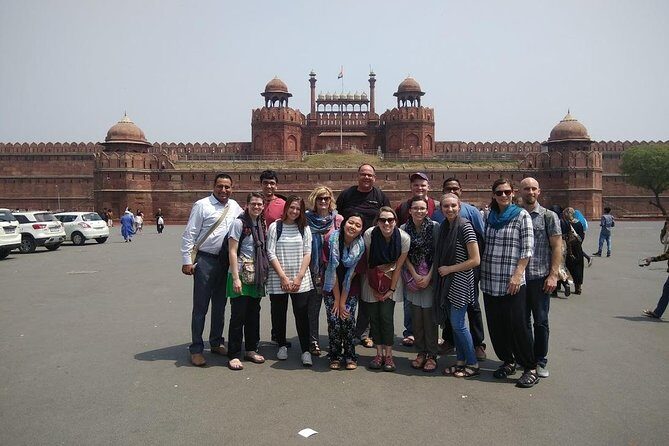
Red Fort, Jama Masjid, and the Old Delhi reality check
Now you’re in the most intense part of the day: Red Fort, Jama Masjid, Chandni Chowk, and a rickshaw ride.
Red Fort is marked as Monday-only by pass in the tour information. That’s another place to verify your actual day’s schedule. The tour description notes it was built by Mughal emperor Shah Jahan, but the key practical detail is that the visit rules may shift depending on the weekday.
Then comes Jama Masjid, founded as Shahjahanabad by Shah Jahan and maintained in a Mughal character in the forms the tour explanation references. The courtyard is described as precise with numbers and able to accommodate 25,000 people. You’ll have about 20 minutes here, but unlike several other monuments, Jama Masjid entrance is not included.
So what does that mean for you? In budget terms, it’s a reminder to plan for small extras even on “all-in” tours. In time terms, it’s also a quick stop—more about getting the feel of the scale than lingering.
The Old Delhi rickshaw ride (the day’s fun factor)
You get a rickshaw ride at Old Delhi. This is one of those experiences that turns a long day into a memory you can actually feel. It’s also a good counterbalance to the earlier formal monuments. Where the earlier stops are about big architecture, the rickshaw is about movement through the city’s human scale.
Pair that ride with the short Jama Masjid time and you get a day that moves from monument to street life without leaving you stranded between them.
Chandni Chowk: free time in Delhi’s old market world
Then you head to Pasar Chandni Chowk, described as the oldest market of Delhi with many food shops. This stop is about 1 hour, and the admission is listed as free.
This is where you can do the “I want to actually see it” part. If you like browsing stalls, watching people buy and sell, or just smelling the street food atmosphere from a distance, this is your moment. The tour data doesn’t promise specific shopping time for any one vendor, but the hour gives you breathing space.
Also, remember: food and drinks are listed as not included unless specified. So if you want snacks, plan to purchase them on your own.
If you want a practical approach, I suggest setting a personal goal before you arrive—something like one snack, one drink, one photo—so you don’t burn the whole hour deciding where to stop.
Raj Ghat: a short, respectful Gandhi moment
The day ends at Raj Ghat, the cremation ground of Mahatma Gandhi. You’ll get about 20 minutes, and the admission ticket is included. The tour notes you can visit or drive past depending on the run of the day.
If you’re visiting Delhi for the first time, this stop balances the earlier imperial and political sites with a figure tied to modern India’s moral and independence story. It’s not a long stop, but it’s the kind of place where people tend to slow down without needing a big schedule.
Price and value: what $25 is really buying you
At $25 for about 8 hours, the standout value isn’t just the monuments—it’s the bundle of “day-savers.”
You’re paying for:
- Round-trip transportation from your hotel
- An English-speaking guide
- Lunch included
- Entrance fees included at multiple monuments (listed stops include Qutub Minar, Humayun’s Tomb, India Gate, Red Fort marked Monday-only by pass, Raj Ghat, and more)
- A rickshaw ride in Old Delhi
This kind of pricing only makes sense if you actually plan to use the included sites and the guide-led commentary. If you’re the type who wants to spend extra time in one place and skip the rest, you might find the day a bit scheduled. But if your goal is a single-day sweep that hits Delhi’s biggest story points, the price-to-coverage ratio looks strong.
One more value point: you’re also given a mobile ticket, which reduces friction at gates.
Small-group touring: what “15 or fewer” changes in Delhi
Delhi days often fall into two problems: either you’re stuck waiting for a big bus group, or you end up lost between stops. This format aims to avoid both.
Keeping the group at 15 people or fewer helps your guide manage the flow. It’s easier to ask questions, and you’re less likely to lose your bearings when you’re walking between crowded areas.
And the tour is described as private for your group, meaning you should expect the experience to be for you rather than shared with unrelated travelers.
Practical tips so the day runs smoother
A few realistic things to get right before you go:
- Wear comfortable walking shoes. Even when a stop is “only” 20–30 minutes, you may be moving through entry lines and around monument grounds.
- Plan for extra costs where noted: Jama Masjid entrance is listed as not included, and food/drinks aren’t included unless specified.
- Check day-specific stops. Both Lotus Temple and Red Fort are flagged with Monday-only by pass notes in the tour details, so your exact weekday can change your day’s feel.
- Keep your camera handy but don’t rush. The schedule mixes quick viewpoint-style stops (like India Gate) with longer viewing time (like Humayun’s Tomb).
Should you book this Delhi day tour?
I’d book it if you want a single, well-organized day that covers both Old and New Delhi without the stress of figuring out transport and tickets on your own. The combo of hotel pickup, lunch included, multiple monument entrances, and an Old Delhi rickshaw ride is exactly how you get value in a city that can wear you out.
I’d think twice if you’re picky about specific entries that are marked with Monday-only by pass notes, or if you hate any situation where you might have to handle a separate entrance (like the Jama Masjid entrance not included part).
If your goal is a practical first-day orientation—and you want the day to feel guided rather than improvised—this is a strong fit.
FAQ
What time does the tour start?
The start time is 9:00am.
How long is the Delhi tour?
It’s listed as about 8 hours.
Is hotel pickup and drop-off included?
Yes. Round-trip transportation from your hotel is included.
Is lunch included?
Yes, lunch is included.
Are monument entrance fees included?
Many are included. The tour data lists admission included for places like Qutub Minar, Humayun’s Tomb, India Gate, Raj Ghat, and others mentioned in the route. Jama Masjid entrance is not included, and Chandni Chowk is free.
Is there a rickshaw ride?
Yes. There is a rickshaw ride at Old Delhi included.
Is the group size large?
No. It’s described as a small group of 15 people or fewer, and it’s set up as a private activity for your group.
Do I get a ticket on my phone?
Yes. The tour includes a mobile ticket.
What is the cancellation policy?
You can cancel for free up to 24 hours in advance for a full refund. The tour also notes it requires good weather and a minimum number of travelers.