REVIEW · UDAIPUR
Secret Cooking Session with the bheel Tribe
Book on Viator →Operated by The Unseen Tribes · Bookable on Viator
Rajasthan can feel oddly quiet here, in the best way. This secret cooking session with the bheel tribe pairs a rock-made Shiva temple stop with a real-life taste of daily tribal culture, including meditation and music. I love how the day is not just food, it is context: you understand where ingredients come from and why people cook the way they do, then you eat what you learn.
My second favorite part is the hands-on Rajasthani cooking you get to witness and practice, starting from local farming and moving into the kitchen. One thing to consider: it runs in the morning and the experience is weather dependent, so if the day turns gray or rainy, you may need to reschedule to keep the walk and nature time comfortable.
In This Review
- Key things to know before you go
- A morning in Udaipur that smells like earth and warm spices
- Chandpole Gate start and the naturally-made rock Shiva temple
- Tribal homes built from mud, cow dung, and straws
- Wheat fields and traditional farming you can actually picture
- Buffalo-milk jaggery tea and Satsang for the ears
- The secret cooking session: from traditional methods to a real meal
- The hard conversations: caste system, dowry, child marriage, honor violence
- Nature time and trails: what your body should expect
- Price and value: is $50 fair for 5 hours?
- Who should book this, and who might prefer something else?
- Should you book this Secret Cooking Session with the bheel Tribe?
- FAQ
- FAQ
- Where does the experience start?
- How long is the experience?
- What time does it run?
- What does the tour include besides cooking?
- Do you get to eat the food you make?
- How big are the groups?
- Is a mobile ticket provided?
- What happens if the weather is bad?
- Is it easy to reach the meeting point with public transport?
Key things to know before you go
- Rock Shiva temple stop where people have meditated for generations
- Mud, cow dung, and straw homes and a look at how they’re built
- Traditional wheat farming with practical farming techniques
- Buffalo milk tea with jaggery and herbs before the cooking begins
- Satsang and meditation for a cultural reset, not just sightseeing
- Small group capped at 20 people, with a local host who makes the day feel personal
A morning in Udaipur that smells like earth and warm spices
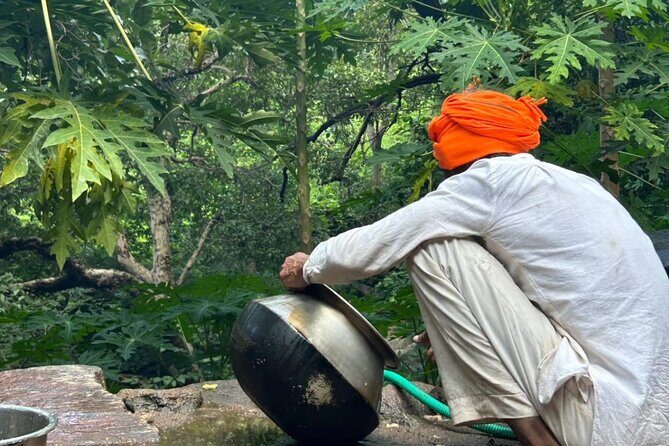
This is the kind of Udaipur experience that doesn’t ask you to stay glued to a phone. You meet at Chandpole Bridge / Chandpole Gate in the old city area, then you move away from the main tourist swirl into fields, paths, homes, and a kitchen process that feels like it belongs to the land.
The promise here is simple: you start with spirituality, you learn daily tribal life, and you end with food you can actually taste. Along the way, you get what most food tours skip: the conversations that connect ingredients to history, values, and survival skills.
And yes, there is walking. It is not advertised as a hardcore hike, but you should expect a morning that includes trails, time outside, and some movement between stops.
You can also read our reviews of more cooking classes in Udaipur
Chandpole Gate start and the naturally-made rock Shiva temple
Your morning begins in Udaipur’s old city, near Chandpole Bridge (Ambamata side). The start time sits in a broad window of 7:00 AM to 12:00 PM, which is perfect if you like cooler air and softer light. Ending back at the meeting point keeps it easy, especially if you’re already sightseeing around the city center.
The first major stop is a Lord Shiva Temple naturally made of rocks. It’s not presented as a quick photo op. You’re there to sense the spiritual energy, and the experience notes that many people have meditated in this temple for all their lives. That matters, because it changes how you should act: you’re not just observing. You’re sharing the space, quietly absorbing the mood, and letting the morning slow down.
Practical tip: dress respectfully for a temple visit. You do not need to overthink it, just make sure your clothing covers appropriately for a religious space and that you can comfortably move in it.
Tribal homes built from mud, cow dung, and straws
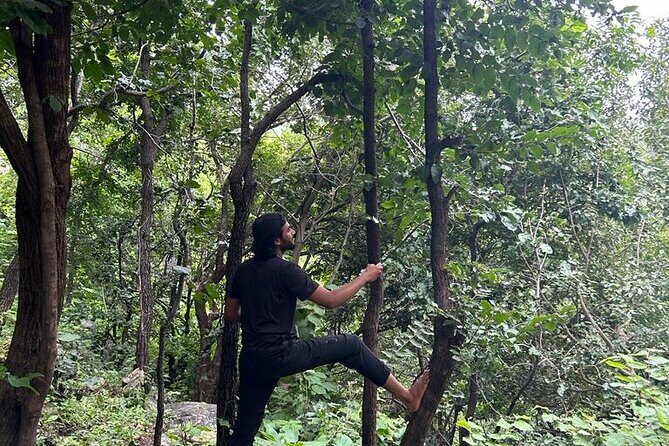
After the temple, you shift into everyday life. You visit a tribal house built with mud, cow dung, and straws. Seeing construction materials like this up close does something that pictures can’t: it connects you to local knowledge, to what works where you live, and to how people shape shelter with what the region provides.
This is also where you start learning the practical side of culture. The day is framed around daily life and healthier living with almost no money. I like how the experience doesn’t treat tribal life like a museum. You’re meeting people, seeing how they live, and hearing what matters to them.
One extra cultural detail to keep in mind: in at least one shared account, kids showed respect in a very direct way, including touching feet. If that happens to you, the best move is to stay calm, be polite, and follow the host’s guidance for what feels appropriate in the moment.
Wheat fields and traditional farming you can actually picture
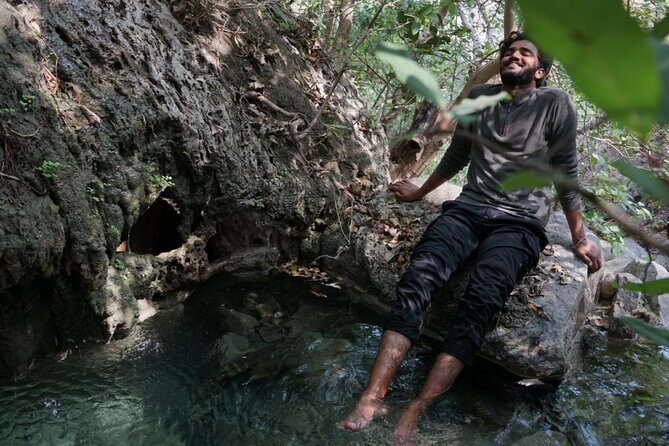
Next comes the land itself: wheat fields and traditional farming techniques. This is one of the best parts for food lovers, because it turns ingredients into a story you can follow.
Instead of just being told that wheat grows here, you learn how farmers grow crops in traditional ways. That gives you a more grounded way to understand the cooking session later. You’ll start noticing the links: what the fields produce, how people plan meals, and why certain flavors and methods make sense.
If you’re the kind of person who likes nature time, you’ll also appreciate that the experience builds in spending time in nature, not only passing through it. Think of it as a gentle morning walk that teaches you how to look.
Buffalo-milk jaggery tea and Satsang for the ears
Sometime in the middle of the morning, you’ll get a special tea made with fresh buffalo milk, jaggery, and herbs. It’s simple and local, and the ingredients list alone tells you it’s not a generic souvenir drink. Buffalo milk changes the richness. Jaggery adds depth instead of just sweetness. Herbs bring the whole thing into a medicinal, everyday category.
Then comes Satsang, described as regional music. This part is important because it isn’t just entertainment. It’s presented as a lived voice—tribal people’s music and sound as part of daily identity.
In shared experiences from earlier participants, people specifically mentioned how unique the voice of the tribal singers felt during Satsang. That tracks with what this day is doing overall: it keeps returning you to the human element, not just the scenery.





The secret cooking session: from traditional methods to a real meal
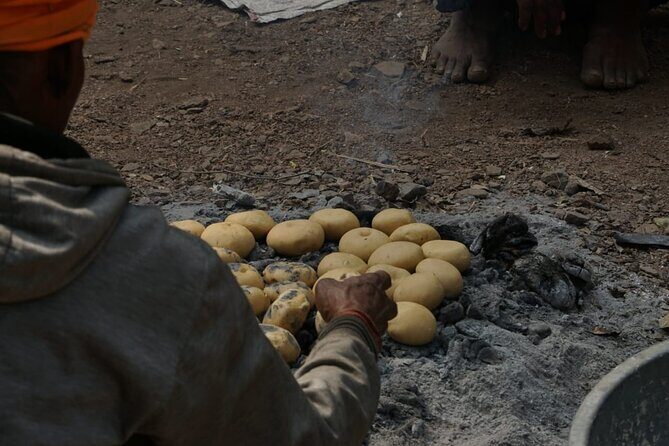
This is the core attraction: you witness how authentic Rajasthani food is made, learn the traditional way of cooking, and then eat the authentic Rajasthani food prepared by the best.
What makes this valuable is the sequence. You don’t jump straight into a kitchen lesson with no context. You’ve already visited the temple, seen home materials, walked the fields, and had the buffalo tea. So when you start cooking, you understand what you’re doing. It becomes less like a class and more like a transfer of local habits.
You should expect the day to focus on practical learning:
- how ingredients behave in traditional methods
- how cooking steps relate to what’s available locally
- how the meal fits into a full morning of culture
If you’re used to restaurants and polished cooking demonstrations, this may feel more grounded and slower—in a good way. You’re not being wowed with tricks. You’re being brought into how a family or community prepares food.
And you’ll finish by eating it together, which is the real payoff. In food experiences, tasting is the only syllabus that matters.
The hard conversations: caste system, dowry, child marriage, honor violence
This experience includes “deep conversations” and specific factual topics. You’ll talk about things like the caste system, dowry, child marriage, honor killing, and the Sati system. You’ll also hear about the history of Udaipur and more local context—plus the fact that cows are considered holy and still seen on streets.
How you handle these topics matters. This is not a history lecture meant to shock you. It’s presented as part of understanding life, survival, and social structures in the region. Still, some themes are heavy.
My practical advice: go in with patience and respect. If you’re uncomfortable with difficult social history, you might want to choose a lighter cultural activity instead. But if you’re ready to understand how communities work—both what happens and what people are trying to change—these conversations give the day real meaning.
Nature time and trails: what your body should expect
The day includes time in nature, fields, and trails. Some participants have described it as a hike to Rajasthan tribes that they remembered for a long time. Others mentioned that different trails were used, so you’re not stuck doing the exact same path the whole way.
That suggests the morning isn’t only about sitting and watching. You should expect to be outside for stretches, including walking between stops. It’s not a marathon, but comfortable shoes matter.
If you’re going as a solo person, there’s a reassuring element: one person shared that the host Aditya helped them feel comfortable when they had no other booking and were taken alone. Even if you’re not traveling solo, small-group attention can make a difference on a day that includes temple space, homes, and sensitive topics.
Price and value: is $50 fair for 5 hours?
At $50 for roughly 5 hours, this is priced like a small-group cultural morning with multiple included elements. You’re not only paying for a guide and a meal. You’re also paying for:
- temple and cultural visits
- time with tribal people and home/farming learning
- buffalo-milk tea
- watching and learning traditional cooking
- eating the food you help understand
In places like Udaipur, cheaper experiences often mean fewer included pieces or more time spent in big-city format activities. Here, the structure is tight: you start early, you stay focused, and you cover several meaningful stops in one run.
Also, the group size cap of up to 20 people supports the feeling that this day is personal, not factory-made. That’s part of the value for me: it gives the host a chance to actually talk, not just move the group along.
Who should book this, and who might prefer something else?
You’ll likely love this if:
- you care about authentic food that connects to local farming
- you want a morning that includes temple space, music, and meditation, not only sightseeing
- you enjoy conversations that go beyond surface culture
- you want a small-group experience that stays away from crowds
You might reconsider if:
- you dislike walking and time outdoors
- you prefer upbeat topics only (because you will discuss difficult social history)
- you need a flexible schedule that can handle weather changes, since the experience is weather dependent
As a practical note, it’s scheduled Monday through Sunday in the morning hours, and you’re back at the meeting point by the end, which makes it easier to fit into a Udaipur itinerary.
Should you book this Secret Cooking Session with the bheel Tribe?
Yes, if you want Udaipur to feel real in the way that food and culture actually connect. This isn’t just eating. It’s learning why people cook, how homes are built, how farming works, and how music and meditation shape the day.
Book it if you’re open to respectful cultural exchange and you don’t mind that some conversations are heavy. If that sounds like your style, the $50 price starts to feel like a fair trade for a morning that teaches you more than it entertains.
FAQ
FAQ
Where does the experience start?
It starts at Chandpole Bridge, Ambamata, Udaipur, Rajasthan 313004, India.
How long is the experience?
The duration is about 5 hours.
What time does it run?
It runs 7:00 AM to 12:00 PM, Monday through Sunday.
What does the tour include besides cooking?
It includes a temple visit, interaction with tribal people, visiting tribal homes, time in nature and fields, traditional farming techniques, tea with buffalo milk and herbs, Satsang, meditation, and deep conversations.
Do you get to eat the food you make?
You eat authentic Rajasthani food that is made as part of the experience.
How big are the groups?
The experience has a maximum of 20 people.
Is a mobile ticket provided?
Yes, it’s listed as a mobile ticket.
What happens if the weather is bad?
The experience requires good weather. If it’s canceled due to poor weather, you’ll be offered a different date or a full refund.
Is it easy to reach the meeting point with public transport?
Yes, the meeting point is listed as near public transportation.
If you want, tell me your travel dates and your walking comfort level, and I’ll help you decide whether the 7 AM timing fits your Udaipur plan.