REVIEW · JAIPUR
Private Full-Day Jaipur Sightseeing Tour by Car with Driver
Book on Viator →Operated by Jaipur Private Cab · Bookable on Viator
Jaipur looks best when you can move fast and stay comfortable, and this private car tour is built for exactly that. You start with hotel pickup and roll through the city’s biggest sights in an air-conditioned vehicle, guided by an English-speaking driver who shares practical context as you go. Two big reasons I like it: you get tight stop-to-stop timing (so you’re not losing half the day in transit) and you also get quieter, meaningful stops like Panna Meena ka Kund and Royal Gaitor rather than only the loudest landmarks.
I also like that the experience feels personal. In real use, drivers like Aslam and Soni have been described as on-time, respectful with schedules, and easy to trust, and Malik Khan and Suresh Ji have been noted for being friendly and helpful—so the day doesn’t feel like a rushed bus tour.
One thing to consider: monument entrance fees and lunch aren’t included, so you’ll want to budget a bit extra once you’re in town. Also, some sites have listed tickets as not included, which can change your total depending on what you decide to enter.
In This Review
- Key highlights worth planning for
- Getting Around Jaipur in Comfort (Not in Traffic Stress)
- The Pickup Advantage: How Drivers Make or Break the Day
- Stop 1: Amer Fort (Fort of Amer) and the Old Capital Story
- Panna Meena ka Kund: The Stepwell Where Rainwater Becomes Architecture
- Stop 2: Jal Mahal and the Water Palace Moment
- Stop 3: Royal Gaitor Tumbas for a Calmer Pause
- Stop 4: Jantar Mantar, the UNESCO Astronomical Toolkit
- Stop 5: City Palace and the Courtyard World of Jaipur’s Rulers
- Stop 6: Hawa Mahal and the Meaning of 953 Windows
- Stop 7: Albert Hall Museum in Ram Niwas Garden
- Price and Value: What $10.84 Per Person Really Covers
- When a Private Car Tour Makes the Most Sense
- Practical Tips So the Day Runs Smoothly
- Should You Book This Private Full-Day Jaipur Tour?
- FAQ
- What does the tour price include?
- How long is the Jaipur sightseeing tour?
- Is the driver English-speaking?
- Are entrance fees included for monuments?
- Is lunch included?
- Is free cancellation available?
Key highlights worth planning for
- Amer Fort + Panna Meena ka Kund: fortress views plus that hypnotic stepwell geometry
- Royal Gaitor’s quieter pace: carved cenotaphs with less street noise nearby
- Jantar Mantar and City Palace close together: you’re in the same historic core area
- Hawa Mahal’s 953 windows: a façade designed for breeze, not just photos
- Albert Hall Museum time saver: Indo-Saracenic architecture in Ram Niwas Garden
- Private, air-conditioned transport: easier in heat and easier with families
Getting Around Jaipur in Comfort (Not in Traffic Stress)
Jaipur is the kind of city where you really feel the difference between driving yourself and having a driver. This tour handles the driving, parking, and road logistics with a private, clean, air-conditioned vehicle. Translation: you spend your energy looking at monuments instead of studying maps while honking goes on all around you.
The best part is how the day is paced. You get a full lineup—Amer, water and royal landmarks, major UNESCO sites, plus a museum—without the usual scramble. The stops are spread across different areas, and doing that by taxi-hop (on your own) can turn into wasted hours. Here, the structure is the value.
I also appreciate that this is designed for a private group only. That matters when you have kids, grandparents, or anyone who needs a calmer rhythm. In real life, drivers have been described as patient and respectful about your timing at each stop, and that’s exactly what you want when sites have different entry lines and walking distances.
You can also read our reviews of more private tours in Jaipur



The Pickup Advantage: How Drivers Make or Break the Day
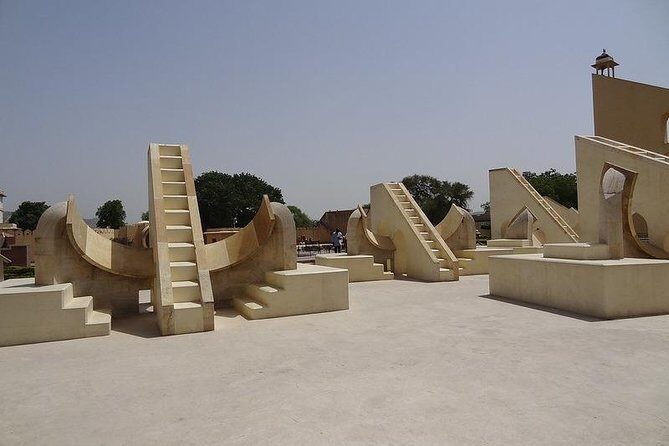
Pickup and drop are included from your hotel, airport, or railway station, which is a big deal in Jaipur. You avoid the awkward part where you’re trying to find the right car in a busy area while you’re already carrying baggage or dealing with jet lag.
The driver experience is a standout theme in the feedback you provided. People mention English-speaking drivers (Soni is one name that came up), and they also mention drivers arriving early—about 15 minutes earlier in at least one account. That early timing does real work: it helps you get to Amer before crowds tighten up and keeps the full-day plan from sliding late.
A small detail I’d take seriously: one driver even used music during the ride, with the vibe described as cool and non-annoying. That’s not essential sightseeing content, but it’s a nice sign of how the day is managed—comfortable car, calm tone, and a driver who is thinking about how you experience the journey.
Stop 1: Amer Fort (Fort of Amer) and the Old Capital Story
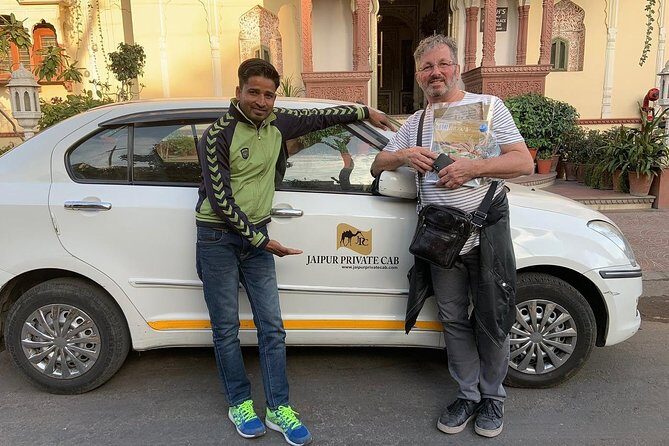
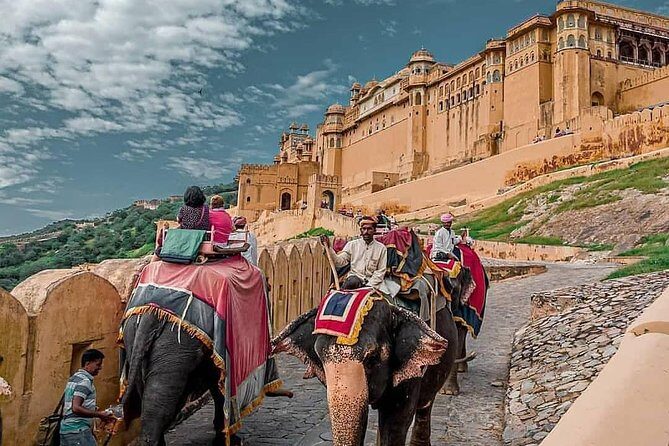
Amer is where the day starts, and it’s a strong choice. The Fort of Amer sits about 11 kilometers from Jaipur, and it used to be the capital before Jaipur grew into what you see today. That one fact changes how you look at the buildings. You’re not just seeing a landmark—you’re seeing a place that once mattered as a political center.
The fort dates to 1592, built by Raja Man Singh. The tour frames Amer as an “old fort” and calls it the Amer Palace, which is a helpful way to connect its identity with the wider fort complex. If you like understanding why a place exists (not only what it looks like), this is the kind of opening that sets the tone for the rest of the itinerary.
Timing is practical here: you’ll have about 2 hours at Amer. That’s long enough to walk and take in details, but it’s also realistic. If you try to add extra stops on your own, Amer can swallow time. With this structure, you’re much less likely to lose the rest of your day.
What to watch for: Amer is a big site. You’ll likely move between viewpoints and courtyards, so comfortable shoes matter. If you’re sensitive to heat or stairs, tell the driver early and keep an eye on pacing.
Panna Meena ka Kund: The Stepwell Where Rainwater Becomes Architecture
After Amer, you’ll visit Panna Meena ka Kund, a stepwell in the Amer area. This is the kind of stop that often gets overlooked on quick tours. Here, it’s given real time—about 2 hours—and that signals it’s worth your attention.
It was built in the 16th century and designed by a Brahmin. The original purpose matters: it collected rainwater during monsoons, and it also supported daily life like bathing and washing clothes. That gives the structure a human job, not only a scenic role.
One reason this stop lands well is the design. The tour description highlights systematic staircases where the steps descend from higher ground down to the pond area. That means you can see how engineering solved practical problems—water access and storage—using geometry you can literally walk through.
Admission is listed as free for this stop, which is a nice bonus in a day where some other sites charge entry. It’s also a good break from the larger, more crowded monuments. You can slow down here and let your eyes do the work.
Stop 2: Jal Mahal and the Water Palace Moment
Jal Mahal—also called the Water Palace—sits inside Mansarovar Lake. Even with a quick 15-minute stop, it can make an impression because of the setting. In winter, the lake may be dry, but during monsoons it fills, and the water hyacinths can turn the view into something soft and almost cinematic.
Rajput-style architecture is part of the appeal. But the real draw is the contrast: a palace-like façade sitting in a lake that isn’t always a lake. That’s exactly the kind of place where the landscape conditions change your experience.
Two practical notes. First, because the stop is short, focus on the exterior views rather than expecting a deep dive. Second, if you’re taking photos, treat it like a “quick capture” moment rather than a long sit-down.
A few more Jaipur tours and experiences worth a look




Stop 3: Royal Gaitor Tumbas for a Calmer Pause
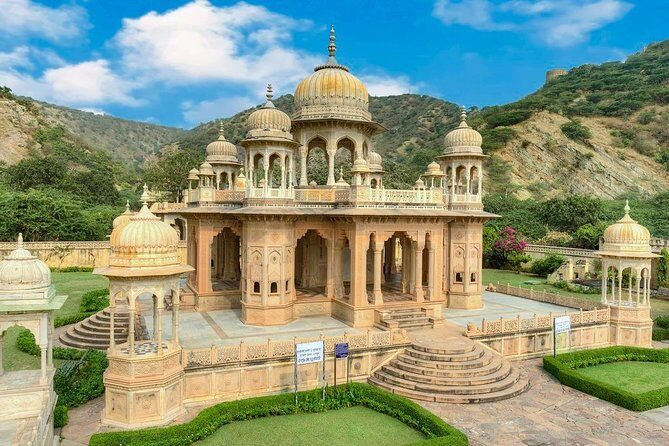
Next up is Royal Gaitor, a funerary complex with intricately carved cenotaphs for Jaipur’s former rulers, including Jai Singh II. The tour description highlights something you’ll feel instantly once you arrive: this place is quieter than many of the “main attraction” stops in Jaipur.
That quiet is the value. After forts and palace exteriors, Royal Gaitor offers craftsmanship in a slower setting. It’s a good choice if you want a bit of breathing room in the middle of a packed day.
Plan for about 1 hour here. That length is about right for walking the grounds, appreciating carvings, and then moving on before the day gets too hot or too tiring.
Admission is listed as not included, so you may need to pay at entry depending on what you choose to do.
Stop 4: Jantar Mantar, the UNESCO Astronomical Toolkit
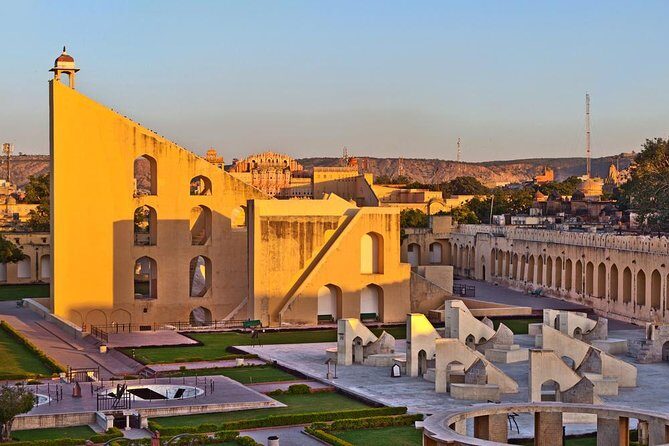
Then comes one of Jaipur’s “only here” sights: Jantar Mantar. It’s a set of nineteen architectural astronomical instruments built by Sawai Jai Singh II, who founded Jaipur. The tour notes the monument was completed in 1734, and that it’s a UNESCO World Heritage site.
The headline feature is the world’s largest stone sundial, which is exactly the kind of detail that helps your brain picture what you’re seeing. This isn’t random stonework. It’s an instrument set—built to measure, predict, and track the sky using solid, lasting materials.
You’re in this area near major sights, and the itinerary places it close to City Palace and Hawa Mahal. That matters because it reduces backtracking and keeps your energy for walking.
You’ll have about 1 hour at Jantar Mantar. That works well because it gives enough time to understand the main instruments without letting you get stuck in one corner too long.
Admission is listed as not included, so treat that as part of your planning.
Stop 5: City Palace and the Courtyard World of Jaipur’s Rulers
The City Palace of Jaipur sits in the heart of the Pink City. The tour description frames it as the seat of the Maharaja’s rule, which is a helpful way to interpret the complex rather than treating it like a single building.
City Palace isn’t just one structure. It’s made up of courtyards, pavilions, gardens, and temples—so it’s more like a world. The itinerary notes it includes famous parts such as Chandra Mahal and Mubarak Mahal.
Construction is dated to 1729 to 1732 AD under Sawai Jai Singh II. That matters because the complex isn’t a medieval accident—it’s planned, organized, and tied to a specific era of Jaipur’s growth.
You’ll get about 2 hours here, which is right for navigating multiple areas and taking your time with architecture and layout. If you rush, you’ll miss the “courtyard logic” that makes the palace complex feel lived-in and functional.
Admission is listed as not included, so be ready for entry costs if you want full access.
Stop 6: Hawa Mahal and the Meaning of 953 Windows
If you only remember one façade from Jaipur, it might be Hawa Mahal—the Palace of Wind. It’s located in Badi Choupad in the Pink City and built in 1799.
The standout fact is the 953 windows on the outside walls. The honeycomb-shaped design and carved openings are meant for breeze movement. That means Hawa Mahal wasn’t made only for looks. It was designed for ventilation and comfort, using architectural “holes” that still look gorgeous today.
The tour description also notes it was built as an extension to the City Palace nearby. That connection helps: Hawa Mahal makes more sense when you see it not as a standalone novelty, but as part of the royal complex’s expansion.
You’ll have about 1 hour at Hawa Mahal. For most people, that’s the right amount of time to walk the exterior views, take photos, and get a handle on the façade’s rhythm.
Again, admission is listed as not included, so check entry expectations on the day.
Stop 7: Albert Hall Museum in Ram Niwas Garden
To finish strong, the itinerary includes the Albert Hall Museum, located in Ram Niwas Garden just outside the city wall and across from New Gate. It’s described as the oldest museum in Rajasthan and also serves as the state’s official museum.
I like this stop because it changes pace. After palaces and forts, a museum lets you slow down and connect objects to the bigger story the monuments are telling. The building’s Indo-Saracenic architecture is a real draw, too, so even if you only skim galleries, the structure itself is worth seeing.
The museum stop is about 45 minutes. That’s short enough to keep you from getting museum-fatigued, but long enough to browse key rooms and get a feel for what the collection covers.
Admission is listed as not included, so budget accordingly if you plan to go inside.
Price and Value: What $10.84 Per Person Really Covers
At $10.84 per person for an approximately 8-hour private car tour, the value mostly comes from what’s included: hotel/airport/railway station pickup and drop, a private clean air-conditioned vehicle, and coverage for fuel, parking, toll taxes, and interstate taxes. That last part matters more than you might think, because those costs add up fast when you’re doing a full loop of Jaipur sights.
You’re also getting local stories associated with each place, and English-speaking driver support as part of the plan. If you select the option with a guide, a private tour guide can be included too.
What’s not included is also important. The tour clearly lists monument entrance fees as not included, and lunch isn’t included either. Jal Mahal and Panna Meena ka Kund are listed with free admission in the itinerary notes, but many of the other big stops are ticketed.
So here’s the practical way to think about it. The base price pays for movement and interpretation. Your extra spending goes mostly toward entry tickets and food. If you’re traveling as a couple or with family, private transport can still be a strong deal compared to separate taxis across long distances and heavy entry-ticket days.
When a Private Car Tour Makes the Most Sense
This tour fits best if you’re:
- Seeing Jaipur for the first time and want the main sights without planning chaos
- Traveling with kids, older relatives, or anyone who prefers not to navigate heat and traffic
- Short on time but still want a balanced mix: forts, observatories, palaces, and a museum
One review detail in your info really points to this. A private car was described as essential for traveling during hot summer months. Even if your comfort needs are different, the core logic holds: air-conditioned transport lets you keep sightseeing energy longer.
If you’re a hardcore “I want every detail and zero time limits” type, you might feel that some stops are timed tightly. But for most first-time visitors, the mix and pacing are exactly what you want.
Practical Tips So the Day Runs Smoothly
A few small moves will make this day easier:
- Bring a little cash or a payment method for monument entrance fees since they aren’t included for many stops
- Wear comfortable shoes for forts and complexes with lots of walking
- Carry water and sun protection. Jaipur sun can turn a short walk into a long one
- If you’re sensitive to stairs at Amer or the stepwell, tell the driver early so pacing stays comfortable
Also, since this is private, you can usually adjust your rhythm with the driver. One theme from the driver feedback you shared is respect for your time at each attraction—so don’t hesitate to mention what you want to prioritize.
Should You Book This Private Full-Day Jaipur Tour?
I’d book it if you want the biggest Jaipur hits in one day with a setup that reduces hassle. The private car part is the real win: it keeps the day moving, it keeps you comfortable, and it gives you a driver who can explain what you’re looking at.
Skip it (or at least think twice) if you hate paying entrance fees on the spot, or if you’re expecting lunch to be handled for you. This tour is about sights and transport, not all-day meals.
If you’re planning a Jaipur day from a hotel, airport, or train station, this is a sensible, low-stress way to see a lot of ground without turning the day into logistics.
FAQ
What does the tour price include?
The price includes hotel/airport/railway station pickup and drop, a private clean air-conditioned taxi for the full day, fuel, parking charges, toll taxes, and local stories connected to each stop. A private tour guide may also be included if you choose the option for it.
How long is the Jaipur sightseeing tour?
The duration is listed as approximately 8 hours for the full-day itinerary.
Is the driver English-speaking?
Yes, the tour description includes an English-speaking driver.
Are entrance fees included for monuments?
Monument entrance fees are not included in general. Some items are noted as free in the itinerary (for example, Panna Meena stepwell and Jal Mahal), while several major sites list admission as not included.
Is lunch included?
No, lunch is not included.
Is free cancellation available?
Yes. You can cancel for a full refund up to 24 hours in advance of the experience’s start time. The experience also notes that it requires good weather; if it’s canceled due to poor weather, you’ll be offered a different date or a full refund.