REVIEW · JAIPUR
Jaipur Full Day City Tour visit Hawa Mahal, Amber Fort & City Palace
Book on Viator →Operated by Nikita Holidays · Bookable on Viator
A day in Jaipur moves fast. This full-day city tour is built around the big-name sights of the Pink City, with private air-conditioned transport and a guide who helps you connect the dots between forts, palaces, and everyday royal life. It’s also a good mix of photos, history, and time for colorful market shopping.
The main catch: it’s a 9-hour schedule, so you’ll be on the move and some stops are purposely short.
I like how the morning starts with Hawa Mahal, so you get that famous honeycomb façade before the day gets hectic. I also like that the tour doesn’t just point at monuments—it usually includes a local guide and hands-on style stop(s), like carpet-weaving and precious-stone cutting/polishing demonstrations, which make the culture feel practical instead of museum-only. If you get a guide like Ashok Sharma, you’ll likely appreciate the clear, attentive way he explains what you’re seeing and why it matters.
If you’re the type who hates tight timing, plan for a “see it, then go” pace. Everything still feels worth it, but you won’t have hours to wander unstructured.
In This Review
- Key Highlights You’ll Actually Feel During the Day
- The 8am-to-5pm Plan: How the Tour Keeps You From Wasting Time
- Hawa Mahal: The Honeycomb “Palace of Winds” With Maximum Photo Potential
- Amber Fort: When Jaipur’s Power Looks Bigger Than the Map
- Jal Mahal: A Quick Waterfront Photo Stop at Man Sarobar Lake
- City Palace of Jaipur: Where Royal Life Still Has a Pulse
- Jantar Mantar and the Guide’s Job: Turning Sights Into Understanding
- The Shopping Stop and Demonstrations: More Than Souvenirs
- Price and Value: Is $44 for This Day Actually Fair?
- What You’ll Learn and What to Ask Your Guide
- Logistics That Matter: Comfort, Dress Code, and Pace
- Who This Tour Suits Best
- Should You Book This Jaipur Full-Day City Tour?
- FAQ
- FAQ
- What time does the Jaipur tour start?
- How long does the tour last?
- Is pickup and transportation included?
- Is a guide included?
- Are monument entrance fees included?
- Is lunch included?
- What demonstrations are included?
- How is the tour ticket handled?
- What is the dress code?
Key Highlights You’ll Actually Feel During the Day
Private A/C vehicle all day means you can keep moving without baking in the Jaipur heat
Hawa Mahal in the morning gives you better light and easier photo conditions
Amber Fort time for the key interiors (not just a quick outside look)
Photo stop at Jal Mahal at the Man Sarobar Lake waterfront
Shopping time built in for jewelry, clothing, and colorful local goods
On-the-day demonstrations (carpet weaving plus stone cutting/polishing)
The 8am-to-5pm Plan: How the Tour Keeps You From Wasting Time
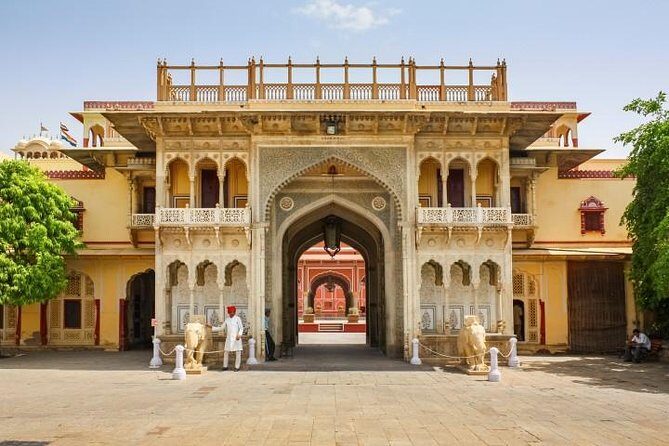
You start at 8:00am with pickup from your hotel, airport, or wherever you’re staying in Jaipur. The tour runs about 9 hours, and you’re typically back by around 5pm.
That long block matters, because Jaipur sights are spread out and the city traffic can be unpredictable. Using one private car for the whole day is the difference between a smooth itinerary and a stressful one. You’ll also have a professional guide in the mix, so you’re not relying on guesswork at each stop.
My practical advice: wear comfortable shoes and keep water handy. The tour is set up so you’re moving between major points, and breaks are mostly wrapped into the sightseeing stops rather than long standalone pauses.
You can also read our reviews of more city tours in Jaipur


Hawa Mahal: The Honeycomb “Palace of Winds” With Maximum Photo Potential
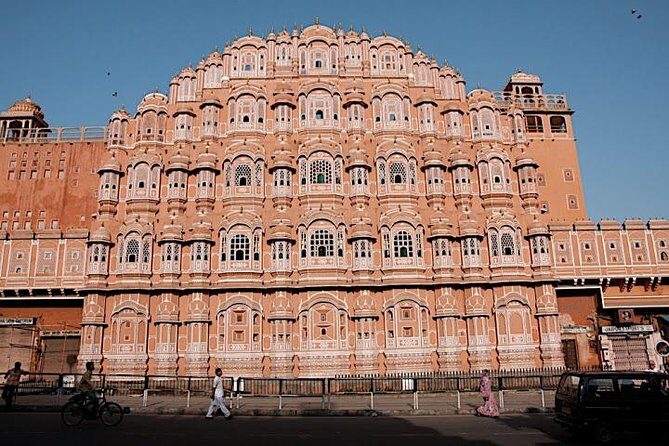
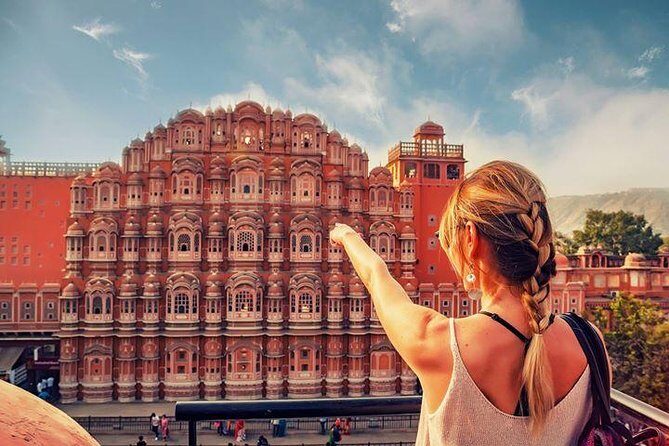
Your first real stop is Hawa Mahal, often called the Palace of the Winds. Even if you’ve seen photos online, seeing it in person hits differently because the façade is built like a carefully designed honeycomb—rows of small openings that look like they could belong on a puzzle piece.
You’ll have about 30 minutes here, and the itinerary lists admission ticket free for this stop. That’s a win if you’re trying to keep costs predictable. The bigger win is timing: starting early makes it easier to photograph the façade and look at details before crowds and heat start to work against you.
What I’d focus on in those 30 minutes:
- Spend a few minutes looking at how the honeycomb openings stack vertically.
- Take photos from more than one angle if your guide sets you up with viewpoints.
- Ask your guide what the design is for—this is where the “Palace of Winds” idea becomes more than a nickname.
A short visit is enough for the main experience. If you want slow, lingering architecture time, you may want more than the tour gives—but for most people, 30 minutes is the right balance.
Amber Fort: When Jaipur’s Power Looks Bigger Than the Map
Next up is Amber Fort, often the headline act for first-timers. You’ll have about 2 hours here, and admission is listed as included for the stop.
Amber Fort sits on a ridge outside the city and has that classic Jaipur look—strong walls, dramatic structures, and a view that makes you understand why this place became a seat of power. There’s also a scenic element: it can reflect beautifully in the lake below (even if you’re not always seeing water at its fullest depending on season and conditions).
Inside, you’ll encounter the Jai Mandir temple. This is one of those stops where a guide really helps, because it’s easy to get lost in what you’re seeing if you don’t have context. The fort is not just one building—it’s a set of spaces, and the story of how people used religion, architecture, and court life is part of the experience.
Two practical considerations:
- Plan for stairs and uneven ground. Comfortable shoes are not optional.
- The fort time is about quality, not quantity—2 hours is enough to cover the core areas without feeling like you missed everything.
If you only do one major fort in Jaipur, Amber Fort is the one you should prioritize.
Jal Mahal: A Quick Waterfront Photo Stop at Man Sarobar Lake
Around 11am, you’ll stop for photos at Jal Mahal, the “Water Palace” in the Man Sarobar lake area. The tour gives you about 30 minutes—so think of this as a striking pause, not a long wander.
Jal Mahal is especially interesting because it’s a perfect example of how Jaipur’s royals used water and views as part of status. One detail to know in advance: the lake is often dry during the summer, while winter monsoons can bring more water. So your exact look at Jal Mahal can vary by season.
How to make the most of a short stop:
- Take a wide shot first to capture the overall palace-in-water idea.
- Then move closer (if accessible) for façade textures and architectural lines.
- Don’t stress if you don’t get the full “water” look—Jal Mahal’s design is the story even in drier conditions.
This is a good stop for quick photos and a mental reset before you head back into palace-history mode.
City Palace of Jaipur: Where Royal Life Still Has a Pulse
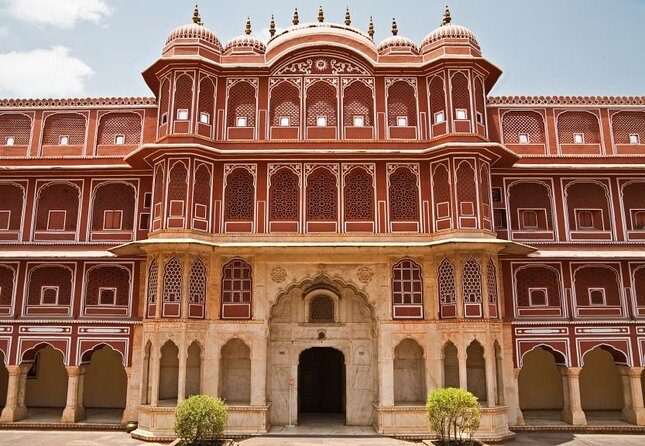
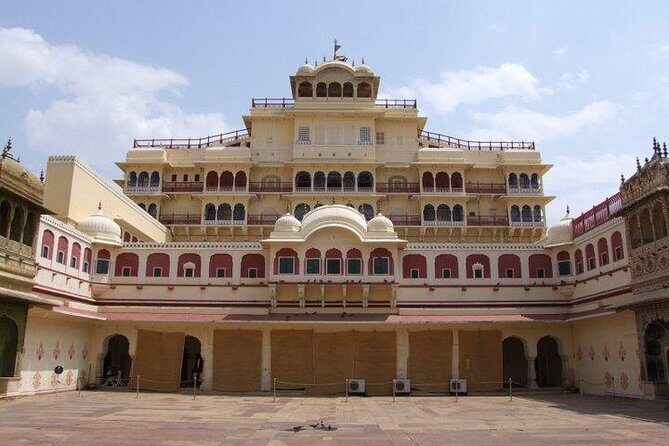
Later you visit City Palace of Jaipur, located in the heart of the old city. You’ll have about 2 hours and admission is listed as included.
This is where the tour stops feeling like a checklist and starts to feel like a living place. The overview notes that Jaipur’s royal family still resides here, which means you’re not only looking at historic walls—you’re seeing a functioning legacy.
The palace complex blends Rajasthani and Mughal styles, so you get a mix of design influences instead of one single “theme.” That matters because Jaipur’s history isn’t one straight line; it’s a mix of kingdoms, trade, and artistic exchange. A good guide helps you spot those stylistic shifts without turning it into a lecture.
What I’d do during the 2 hours:
- Start with the main palace area so you get orientation.
- Leave time to notice details, not just big buildings.
- Ask your guide to explain what you’re seeing in plain terms—style, function, and royal life.
Two hours is a healthy amount of time for City Palace. It’s enough to appreciate the buildings without making you feel like you’re late for the next stop.
A few more Jaipur tours and experiences worth a look





Jantar Mantar and the Guide’s Job: Turning Sights Into Understanding
The tour description also includes the Janar Mantar / Jantar Mantar astronomical observatory as part of the day’s plan. If it’s scheduled into your route, treat it as a “why did they build this here?” stop.
Astronomical sites in India aren’t random stonework. They connect measurement, time, and knowledge with everyday life and royal planning. With a guide, this kind of stop becomes easier to interpret—you’re not just walking past structures, you’re learning how they’re used and what they were meant to do.
If you’re short on patience, this is one of the spots where paying attention for 10 minutes can change your whole take on the day.
The Shopping Stop and Demonstrations: More Than Souvenirs
In the afternoon you get time for shopping, listed as about 1 hour at a gemstone and market-focused stop (you’ll see items like precious stones, silver jewelry, bangles, clothing, blue pottery, and textiles). The tour description also encourages going shopping in Jaipur’s colorful local markets, so expect a mix of stalls and curated commercial areas.
A shop stop can be either relaxing or exhausting depending on how it’s handled. The good version is what this itinerary seems to aim for: you get a block of time without losing the whole afternoon to wandering.
Here’s the value-add part: the itinerary also includes live demonstrations of hand-knotted carpet weaving and the cutting and polishing of precious stones. Even if you don’t buy, demonstrations give you a framework for what you’re looking at. Hand weaving is slow and labor-heavy, and stone work is all about precision—seeing the process helps you understand why certain pieces cost what they cost.
Practical shopping tips for Jaipur:
- If you’re buying textiles or jewelry, ask questions about materials and craftsmanship.
- Don’t commit instantly; Jaipur markets reward a second look.
- Keep cash or a card option ready (the tour itself mentions a mobile ticket, but doesn’t spell out payment methods in shops—so plan your own).
Price and Value: Is $44 for This Day Actually Fair?
At $44 per person, this tour is priced for what you get: a private A/C vehicle, a professional private guide, and (in some packages) monument entrance fees plus buffet lunch.
That “some packages” detail is the only place where you need to be careful. The tour info states:
- Monument entrance fees are included if you book an all-inclusive option.
- Buffet lunch is included if you book that same all-inclusive option.
- Some stops also list tickets as free (like Hawa Mahal in the stop details), but not every entrance is described the same way across all options.
So here’s the value logic I’d use:
- If you choose the all-inclusive bundle, you’re likely covering more of the day’s fixed costs upfront (entrances and lunch), which makes the total value stronger.
- If you choose a less-inclusive option, you might pay more separately at certain points, but you still get the biggest day-saver: the private vehicle and guide.
Also note what you’re not paying for: drinks and gratuities are not included. That’s normal, but you should factor gratuity into your budget if you want a smooth end-of-day experience.
What You’ll Learn and What to Ask Your Guide
The tour is structured around major landmarks, but the guide’s role is what turns those stops into a coherent story. The provided info and named example of a guide style (Ashok Sharma) point to something consistent: guides do best when they’re attentive and when they explain history and culture in a way that helps you connect the dots fast.
When you’re at each stop, ask simple questions like:
- What is the main purpose of this design?
- How does this place reflect Jaipur’s royal lifestyle?
- What should I notice that most first-timers miss?
- How would you describe the Rajasthani versus Mughal influence here?
You’ll get more out of the 30-minute photo stops when you go in with one or two things you want answered.
Logistics That Matter: Comfort, Dress Code, and Pace
This tour has a dress code: smart casual. It’s not about formal wear, but it’s a good idea to avoid anything too sloppy or too revealing, especially when you’re entering palace areas and forts.
Pickup starts at 8am, and the tour ends back at your meeting point. The schedule is approximate in transit time and depends on traffic, which is common for Jaipur—expect some variability.
And again, one more time: the biggest consideration is that it’s a full day. You’ll see a lot, but you won’t have the luxury of long, slow wandering.
Who This Tour Suits Best
This works well if you:
- Want a first-timer-friendly way to hit Hawa Mahal, Amber Fort, and City Palace in one day
- Prefer a private guide to help you understand what you’re seeing
- Like the idea of shopping time without giving up the main sights
- Appreciate cultural demos like carpet weaving and stone cutting/polishing
It might be less ideal if you:
- Want deep, slow museum-style time at each location
- Hate structured pacing and short stops
Should You Book This Jaipur Full-Day City Tour?
If you want maximum Jaipur impact with minimal planning stress, I think this is a solid booking. You’re getting the core sights people come for, plus added value with demonstrations and a proper guide. The private A/C vehicle is a big deal on a long day, and City Palace + Amber Fort is a strong pairing.
Before you book, check whether your option includes the monument entrances and buffet lunch, since that affects your true total value. If you choose the all-inclusive route, the price-to-experience ratio looks especially good.
If you’re ready for a full day of major sights and photos, book it. Just go in with comfy shoes, a realistic pace, and a willingness to let the guide do the heavy lifting on history and meaning.
FAQ
FAQ
What time does the Jaipur tour start?
The tour starts at 8:00am with pickup from your hotel, airport, or another designated meeting spot in Jaipur.
How long does the tour last?
It runs for about 9 hours (approx.), and the tour typically ends around 5pm with transfer back to your hotel, airport, or railway station.
Is pickup and transportation included?
Yes. You get all transfers and sightseeing by an air-conditioned private vehicle, with pickup included.
Is a guide included?
Yes. The tour includes a professional private live tour guide.
Are monument entrance fees included?
Monument entrance fees are included if you book the all-inclusive option. The stop details also list Hawa Mahal as admission ticket free, while other key stops like Amber Fort and City Palace are shown as admission included.
Is lunch included?
A buffet lunch is included in some packages, specifically if you book the all-inclusive option.
What demonstrations are included?
The tour includes live demonstrations of hand-knotted carpet weaving and cutting and polishing of precious stones.
How is the tour ticket handled?
You’ll receive a mobile ticket.
What is the dress code?
The dress code is smart casual.