REVIEW · JAIPUR
Golden Triangle Tours
Book on Viator →Operated by Raj India Tours · Bookable on Viator
Delhi to Jaipur, all in one smooth loop.
This 6-day Golden Triangle trip is built for people who want the big icons without playing detective all day. I like the private-group feel (it’s just your group), and I also like that you get English-speaking guidance plus an owner who says he’ll adapt the plan to your time and budget. One thing to keep in mind: many standout sights require paid entry, and the long days can be tiring in heat—so it’s not recommended for people with heart problems.
In This Review
- Key highlights to notice before you go
- Golden Triangle in six days: what the pace really feels like
- Delhi monuments with a map in your head (Qutub Minar, Humayun’s Tomb, Red Fort)
- India Gate, Lotus Temple, and Jama Masjid: big mood shifts that work
- Agra’s one-two punch: Taj Mahal, Agra Fort, and Mehtab Bagh
- Fatehpur Sikri and Chand Baori: the worthwhile detour
- Jaipur’s full circuit: Amber Fort to Hawa Mahal viewpoints
- How pickup, mobile tickets, and private guiding change the day
- Price and what’s included: where your $343 goes
- Tickets, timing, and weather: the stuff that affects your photos
- Who this tour suits best (and who should choose something else)
- Should you book this Golden Triangle experience?
- FAQ
- How many people do I need to book this tour?
- Is pickup included?
- Are entry tickets included for the attractions?
- Is this a private tour?
- Do you provide mobile tickets?
- What’s the cancellation policy if plans change?
Key highlights to notice before you go
- English support on key stops, starting with Qutub Minar and continuing through major monuments.
- A tight Delhi–Agra–Jaipur loop, with timeboxed visits so you still see a lot.
- Some attractions include admission, like Lotus Temple, Jama Masjid, Fatehpur Sikri, and Jal Mahal.
- Private logistics, including pickup offered and mobile tickets for easier on-the-go coordination.
- Real-world planning flexibility, with fast communication from the tour lead (Raj Kumar Gupta) reported by past bookings.
Golden Triangle in six days: what the pace really feels like
The “Golden Triangle” is popular for a reason. You get three cities that each do something different: Delhi for power and empire, Agra for Mughal grandeur, and Jaipur for Rajput-era design and everyday city life.
Still, six days is not a slow stroll. Think of it as a well-run highlight reel where your guide helps you hit the best angles, avoid dead time, and keep your day moving. On a practical level, that means shorter time blocks at each major site, with the payoff being that you cover a lot of ground without constantly changing plans.
Also, confirm what the operator means by pickup timing. The start time is listed as 12:00 am, and that can only work if your hotel pickup is scheduled with care. If you’re not already in Delhi the day before, ask for the exact pickup plan before you rely on the default timing.
You can also read our reviews of more tours and experiences in Jaipur.


Delhi monuments with a map in your head (Qutub Minar, Humayun’s Tomb, Red Fort)
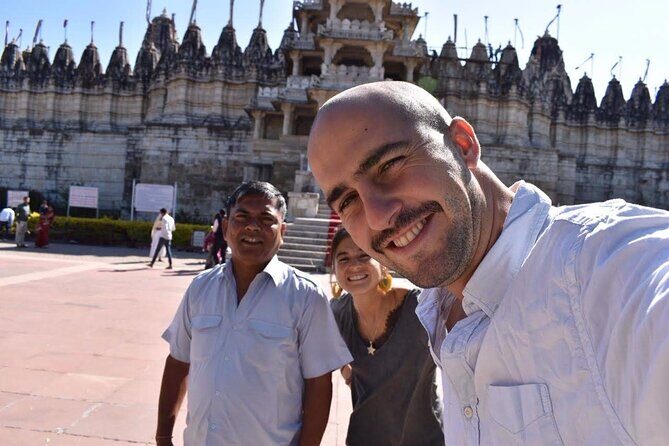
Delhi day is where you build your bearings fast. When I visit Delhi, I want a guide who can explain why each site matters—not just point at buildings. Here, the plan starts with Qutub Minar, where you meet your English-speaking guide and get your first big “wow” moment early enough to set the tone.
From there you move into Mughal-era highlights:
- Humayun’s Tomb: often described as a first-of-its-kind garden tomb in the subcontinent, it’s a calmer experience than some of the louder forts and gates.
- Red Fort (Lal Qila): a historic Mughal stronghold and former royal residence, where the structure tells the story better than any photo.
There’s also a strong mix of culture and worship sites later in the day. That balance is useful. It turns your sightseeing day from one long “architecture museum” vibe into a more real view of how different communities use public space.
Time blocks matter here. Most listed stops are around 30 to 45 minutes. That’s not enough to wander every side street, but it is enough to see the main elements, get good viewpoints, and keep your day from collapsing into exhaustion.
India Gate, Lotus Temple, and Jama Masjid: big mood shifts that work
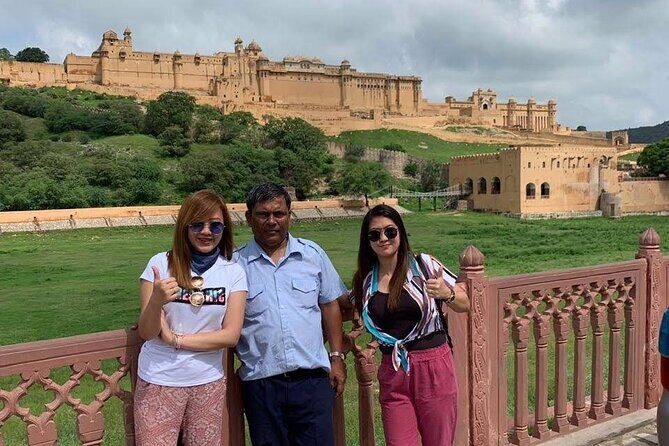
Delhi has extremes: grand ceremonial spaces, modern spiritual quiet, and historic religious architecture. This route uses that mix on purpose.
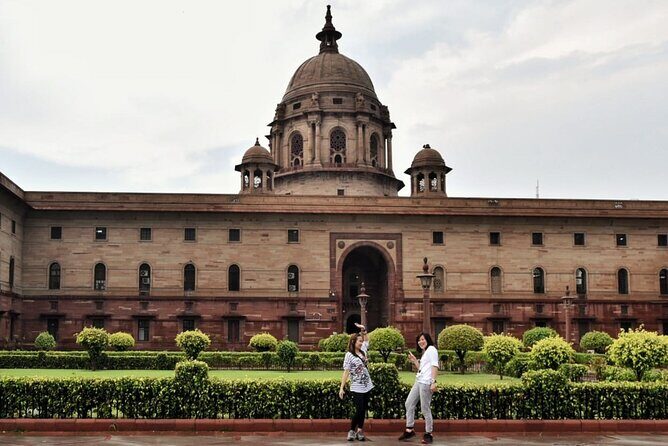
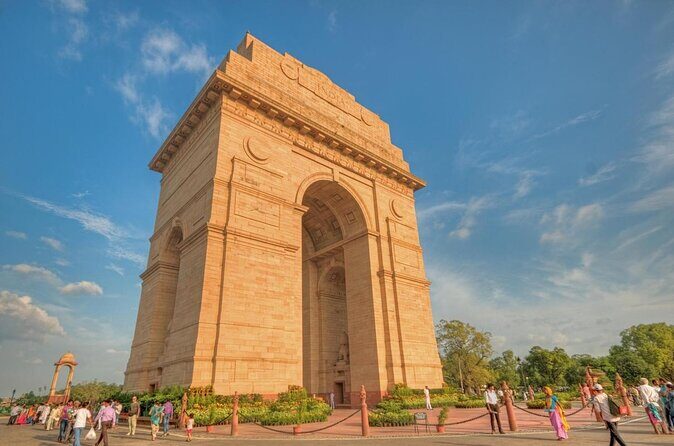
You’ll pass by the All India War Memorial, India Gate, on Rajpath. Even if you don’t spend a long time there, it helps you understand Delhi’s ceremonial layout and the way monuments line up along major avenues.
Then comes the gentler contrast:
- Lotus Temple: a Bahá’í House of Worship known for its flowerlike shape, and it’s listed with admission free. I like this kind of stop because it gives your eyes and brain a break after forts and tombs.
- Jama Masjid: one of the largest mosques in India, built in the mid-1600s by Shah Jahan, with admission also listed as free.
Practical tip: when you’re mixing places of worship with ticketed sites, you should dress like you’re going somewhere formal and respectful. You’ll move fast and take photos, but you’ll also want to avoid anything distracting or too revealing.
Agra’s one-two punch: Taj Mahal, Agra Fort, and Mehtab Bagh
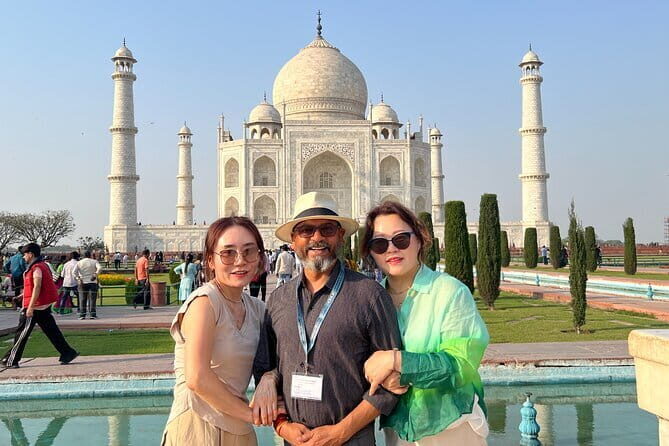
Agra day is a classic for a reason: you get the Taj Mahal, then you get the surrounding story. The itinerary gives you about two hours at the Taj Mahal, which is usually enough time to walk the main grounds, look for key angles, and let the place hit you properly.
Next is Agra Fort, listed for about one hour. Forts can feel repetitive if you’re tired. With a good guide and a set route, Agra Fort becomes more than stone walls—it turns into context for who lived, ruled, and defended this city.
Then there’s Mehtab Bagh, a short stop (around 30 minutes). Even if you’re not there for long, it’s valuable because it changes your perspective. You’re not just looking at the Taj from the same side everyone photographs first.
One consideration: Taj Mahal entry is often the most paperwork in India for your schedule. The entry ticket is listed as not included, so budget time and money for that. If you’re traveling around a busy season, plan for a bit of waiting.
Fatehpur Sikri and Chand Baori: the worthwhile detour
Day 4 is where the trip widens. Instead of only hitting the “most famous famous,” you go to Fatehpur Sikri, a Mughal-founded city area west of Agra, with about two hours planned. Admission is listed as free here, which is a nice cost win.
Fatehpur Sikri tends to feel different from the Taj and Agra Fort. It’s more about scale and spatial layout—big gates and clustered red sandstone buildings. I like these stops because they show Mughal ambition in a way that’s harder to grasp from a single monument.
Then comes Chand Baori (the stepwell) in Abhaneri. It’s listed as about 30 minutes and ticketed (admission not included). Stepwells are one of those “why did they build this” Indian inventions, and they’re excellent for photos without needing an all-day commitment.
Practical tip: stepwells involve uneven edges and sometimes stairs. Wear shoes you trust. You’ll thank yourself later, especially if the weather is warm.






Jaipur’s full circuit: Amber Fort to Hawa Mahal viewpoints
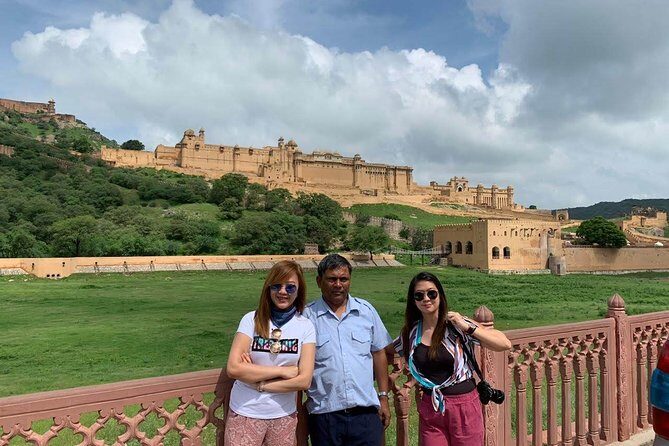
Jaipur day is packed, but it’s a smart kind of packed. Amber Fort is first, listed for about 1.5 hours and ticketed (admission not included). This is where Rajput power becomes visible as architecture and defensive design, not just a story in a guidebook.
Then you get Jal Mahal, the palace in the middle of Man Sagar Lake. It’s listed with admission free and only about 10 minutes. Even though it’s short, it’s worth it. The view hits fast, and it’s a break from heavy walking.
Next up is the City Palace of Jaipur, planned for about 1.5 hours and ticketed. The palace complex works well in a guided format because it’s full of details that connect to how Jaipur was planned and governed.
After that, you visit Jantar Mantar (about 30 minutes), known for astronomical instruments and the large stone sundial completed in 1734. It’s ticketed here too. I like this stop because it’s not just “old stuff.” It’s old science, built into public form.
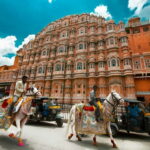
Finally, the plan includes Hawa Mahal, the palace with red and pink sandstone façades extending toward women’s chambers. The itinerary doesn’t list a specific duration or ticket note for it, so you’ll want to ask your guide how much time you’ll have and where you’ll get the best exterior views.
Heat note: Jaipur can be intense. Short stops help, but you’ll still want water and a hat. This is the kind of day where pace is your friend.
How pickup, mobile tickets, and private guiding change the day
This is a private tour/activity, meaning it’s only your group. That matters in India. You don’t get stuck syncing your pace with strangers who want to linger in gift shops.
Pickup is listed as offered, and the tour uses mobile tickets. For me, that’s practical. It reduces last-minute confusion and helps you move through entry points with less fuss.
The guide quality seems to be a real focus. Past bookings mention English-speaking support and cite drivers who were punctual and careful. Names that came up include Nikhileshh and Sunda, plus drivers like Jitendra, Himmat, and Arvind. You might not have the same team, but it does signal that the operator tends to staff with people who communicate and drive safely.
Also, the tour lead, Raj Kumar Gupta, describes himself as having over 20 years in the tourism industry, including driving tourists across northern India and Rajasthan. That background matters. In practice, it often shows up as faster problem-solving when traffic shifts or your timing needs adjusting.
Price and what’s included: where your $343 goes
The price is listed at $343 for about 6 days in the Golden Triangle route. With tours, the key question is always what’s wrapped into that number versus what you’ll pay on arrival.
Here’s the practical reality from the plan:
- Some stops are marked admission ticket free (for example Lotus Temple, Jama Masjid, Fatehpur Sikri, and Jal Mahal).
- Many of the marquee places are marked admission ticket not included, including Qutub Minar, Humayun’s Tomb, Red Fort, Taj Mahal, Agra Fort, Mehtab Bagh, Chand Baori, and Amber Fort, plus ticketed stops in Jaipur like City Palace and Jantar Mantar.
So the $343 looks like a strong value when you’re paying for guiding, transport coordination, and a structured day plan. But don’t assume the attractions are fully covered. Budget extra for entrance fees and any optional experiences that come up.
Meals aren’t mentioned in the data, so you should assume you’ll pay as you go. That doesn’t make the tour worse—just makes it easier to plan. If you want predictable meals, ask about food preferences when you confirm.
One more money-related factor: this tour requires at least 2 people to book. If you’re traveling solo, your total cost per person could change depending on availability and whether a second traveler is needed to confirm the group.
Tickets, timing, and weather: the stuff that affects your photos
This experience requires good weather. That’s not just a legal line. It affects how much you can enjoy open-air sites like forts, tomb grounds, stepwells, and viewpoints.
If weather is poor, the data says you’ll be offered a different date or a full refund. That means you should keep an eye on the forecast in the days leading up to your trip, especially in seasons when Delhi and Agra can get hazy.
Also pay attention to timing blocks like:
- Short Delhi stops (often around 30 minutes)
- A more substantial Taj Mahal window (around 2 hours)
- Medium segments for fort and palace sites (about 1 to 1.5 hours)
If you try to fight the schedule by wandering off, you’ll lose the built-in flow. My advice is simple: let your guide keep you on track, then use your free time window for the places you personally care about most.
Who this tour suits best (and who should choose something else)
This works best if you want a guided “see it all” version of the Golden Triangle. It’s also a good match if you value English-speaking explanations and want transport handled without the stress of organizing everything yourself.
It may not suit you if you:
- Need frequent stops for medical reasons or have limited stamina. The tour is not recommended for travelers with heart problems.
- Want long, slow visits where you spend hours in one place. Here, your time at each stop is structured.
If you like adding personality—markets, extra viewpoints, or changing order—this tour lead says he adapts to your requirements, budget, and time frames. That flexibility can turn a standard route into something that feels more like your trip.
Should you book this Golden Triangle experience?
If you want Delhi, Agra, and Jaipur in a tight 6-day plan with private guiding and pickup support, I think this is a solid option. The pricing looks reasonable for the structure, especially since some admissions are listed as free and the big monuments come with guided help that saves time and makes the sights easier to understand.
I’d book it if you’re comfortable paying entrance fees for many major sites and you’re traveling with at least two people. I’d reconsider if you’re sensitive to heat and long days, or if you need accessibility accommodations—because this route includes lots of walking and open-air time.
One final check before you commit: ask for a clear breakdown of which admissions are included versus not included for your travel dates. That single question helps you budget calmly and keeps surprise costs from stealing your fun.
FAQ
How many people do I need to book this tour?
You need at least 2 people to book the tour.
Is pickup included?
Pickup is offered.
Are entry tickets included for the attractions?
Some admission tickets are marked as free (for example Lotus Temple, Jama Masjid, Fatehpur Sikri, and Jal Mahal), while many other major sights are marked as admission ticket not included.
Is this a private tour?
Yes. It’s a private tour/activity, so only your group participates.
Do you provide mobile tickets?
Yes. Mobile tickets are included.
What’s the cancellation policy if plans change?
You can cancel up to 3 days in advance for a full refund. If you cancel less than 3 full days before the experience starts, the amount paid is not refunded.