REVIEW · AGRA
Golden Triangle Tour from Agra
Book on Viator →Operated by India Voyages · Bookable on Viator
Three cities, one Mughal-meets-modern itinerary, and pickup. I like how this route links Agra’s royal landmarks with Jaipur’s forts and palaces, then lands you in Delhi for big-name history and faith sites. I also like the comfort-first guidance from Sumit and Tabul, with careful attention at each stop. One heads-up: many entrance tickets are not included, including the big ones like the Taj Mahal, so you’ll want to budget for admissions.
Pickup starts at 9:30 am, and the pacing is designed for a true sweep of Agra–Jaipur–Delhi in about 5 days. Taj Mahal timing matters too: it remains closed on Fridays, with your visit shifting to the next morning if your day falls on a Friday.
If you want hours of slow museum time, this tour may feel a bit scheduled. Still, it’s a practical way to see the highlights without getting stuck in planning math and transit confusion.
In This Review
- Key things that make this Golden Triangle tour work
- Golden Triangle From Agra: what you’re really buying
- Agra Fort and the Taj Mahal: setting the Mughal tone in one day
- Fatehpur Sikri: Akbar’s quick detour that pays off
- Jaipur’s Amer and the palace rhythm: forts, lake views, then courtyards
- Jantar Mantar and Hawa Mahal: precision meets romance in pink sandstone
- Delhi monuments: Humayun’s Tomb sets the stage, then you fan out
- Red Fort, Raj Ghat, and Lotus Temple: three kinds of meaning in one finish
- Qutub Minar: a paid highlight that rewards the climb
- Price and value: where $290 really goes
- Guides, comfort, and the kind of safety that matters
- Getting the timing right: Friday Taj Mahal and short stop durations
- Who should book this Agra-to-Delhi Golden Triangle?
- Should you book this Golden Triangle tour from Agra?
- FAQ
- What time does the tour start?
- How long is the tour?
- Is pickup included?
- Are admission tickets included?
- Is breakfast included?
- Does the tour include any free attractions?
- What happens if my trip includes a Friday?
- Is there free cancellation?
Key things that make this Golden Triangle tour work
- Private-group focus with real guide attention: I like that Sumit and Tabul prioritize your comfort and keep the day flowing.
- Smart site mix across 3 cities: Agra, Jaipur, and Delhi are connected by a coherent Mughal-to-royal theme.
- Planned time at the iconic stops: you get set durations for major sights, so your day doesn’t vanish.
- Several meaningful stops are free-entry: Fatehpur Sikri, Amer, India Gate, Bangla Sahib, Raj Ghat, and the Lotus Temple.
- You’re not guessing logistics: pickup, taxes/tolls/parking/driver costs, and mobile tickets reduce friction.
Golden Triangle From Agra: what you’re really buying
This is a 5-day Golden Triangle tour that starts in Agra and works outward to Jaipur and then Delhi. You’re paying for transportation, guided stop-to-stop structure, and a sequence of UNESCO World Heritage–level experiences tied to the Mughal empire and royal India.
At $290 per person, the value is strongest if you’d rather not spend your time researching entry rules, timings, and how to chain sites efficiently. If you’re the type who enjoys hopping between highlights quickly, this format fits well.
The biggest tradeoff is also the most common one on heritage tours: site tickets. You’ll see many paid sights, and the tour lists several as admission ticket not included, so plan spending for entrances.
You can also read our reviews of more tours and experiences in Agra.


Agra Fort and the Taj Mahal: setting the Mughal tone in one day
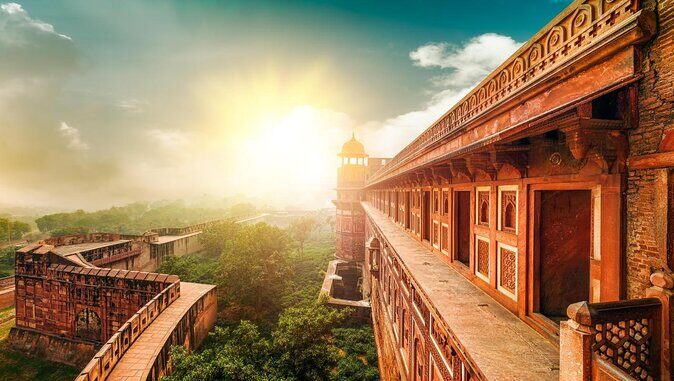
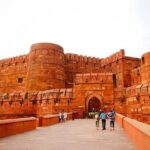
Agra is where the Golden Triangle magic starts, and the route makes a clean statement of intent right away. You begin with Agra Fort, a Mughal-era complex tied to power struggles at the end of Shah Jahan’s life.
You’re given about 1 hour at the fort. That’s enough time to orient yourself, notice how the fort reads like a fortified city, and get a feel for why Agra mattered so much politically. You won’t do a deep, all-afternoon archaeology-and-architecture marathon, but you’ll come away understanding the context before you hit the Taj.
Then comes the Taj Mahal: about 2 hours is allocated for it. This is built by Mughal Emperor Shah Jahan in memory of his wife, and it’s one of those sites where timing really changes your experience. You’ll want comfortable footwear because you’ll be moving around the complex.
Two practical notes that matter:
- Taj Mahal is closed on Fridays. If your tour date lands on a Friday, you’ll visit the Taj Mahal on the next morning.
- Entrance is not included in the tour cost, so you should be ready to pay the official ticket at the gate or through whatever process your operator uses for that stop.
Fatehpur Sikri: Akbar’s quick detour that pays off

The next day slows things down just a bit with Fatehpur Sikri, Akbar’s short-lived capital. It only served as the capital for a limited stretch (about 1572–1585), which is part of the appeal: you’re looking at a place that feels grand, but also slightly unreal in its suddenness.
You get about 1 hour here, and it’s framed as red sandstone buildings clustering around the center of the city. That hour is well chosen. Fatehpur Sikri is not a site where you can fake understanding by looking at one building and leaving; you need a bit of time to connect the overall layout.
Good news for budgeting: Fatehpur Sikri is free admission on this tour. Even if you spend more than you planned taking photos and watching the light, you’re not adding another paid entry on your tab.
Jaipur’s Amer and the palace rhythm: forts, lake views, then courtyards
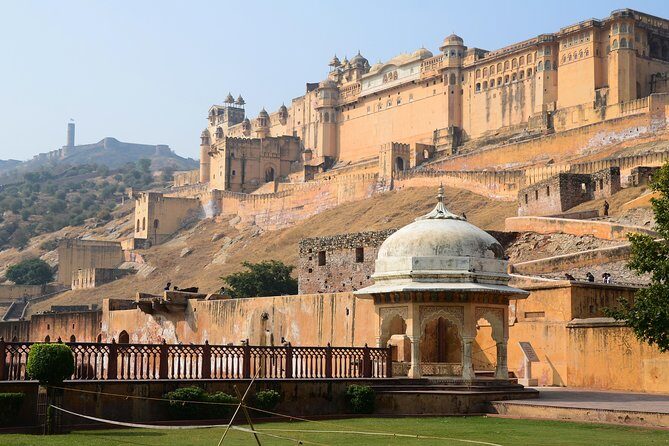
Jaipur is where the royal India vibe becomes very tangible. You start at Amer, the massive fort-palace complex built with pale yellow and pink sandstone and white marble. Expect about 2 hours.
Amer rewards your patience because it’s not just one view; it’s layers. Even if you don’t obsess over architectural details, you’ll feel the shift from fortified defense to ceremonial palace space. It’s the kind of place where a guide helps you read what you’re looking at instead of just pointing at walls.
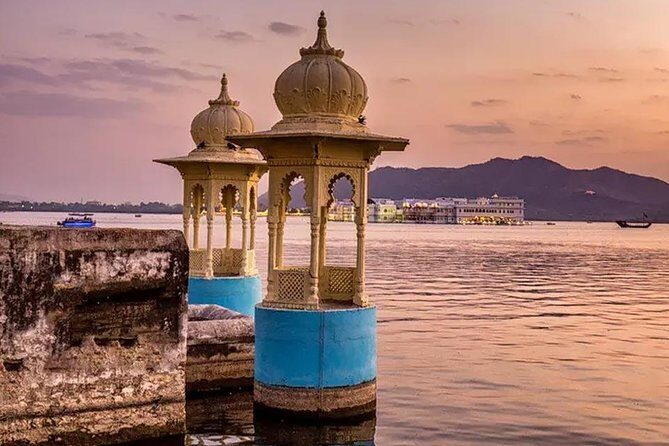
Then you get a quick stop at Jal Mahal, the “palace in the middle of Man Sagar Lake,” constructed in 1799. The time is short—about 10 minutes—so treat it like a framing shot moment. You’ll get a glimpse of why it’s considered so picturesque, but you shouldn’t plan to linger.
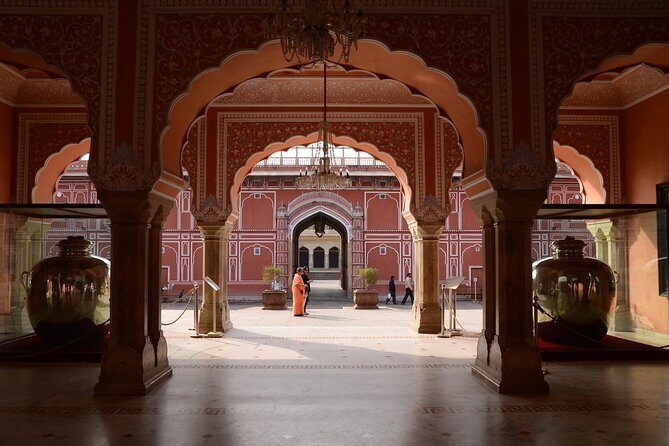
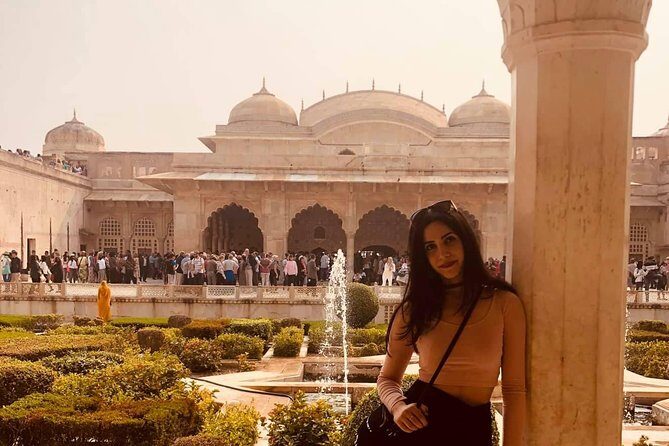
The tour then continues into the City Palace of Jaipur for about 1 hour. This is a broader palace complex with courtyards, gardens, and craft-focused galleries. Entrance here is not included, so this is one of your “budget for tickets” moments.
Jantar Mantar and Hawa Mahal: precision meets romance in pink sandstone
After City Palace, you move to Jantar Mantar, an astronomical instrument site built in 1734 by Sawai Jai Singh II. You’re allocated about 30 minutes.
This is another stop where a guide can change your experience. Without context, you might see stone instruments that look like oversized toys. With explanation, you start realizing this is serious science—built in an era before modern instruments and still impressive in scale. Jantar Mantar is also listed as a UNESCO World Heritage site, which makes it extra worth the time squeeze.
Admission for this stop is not included, so again, treat it as part of your ticket budget.
Next is Hawa Mahal, the Palace of Wind. It’s a five-storey pink sandstone structure with 953 small windows, the jharokhas, traditionally associated with royal women’s chambers. You get about 1 hour, which is enough to appreciate how the building works visually and why the facade is so famous.
Entrance is not included here either. The practical trick: don’t try to read every detail from one spot. Walk to different angles and let the facade do its thing—this is one of those sites where the structure’s design is the story.




Delhi monuments: Humayun’s Tomb sets the stage, then you fan out
Delhi can feel like information overload, so I like that this route gives you a strong entry point with Humayun’s Tomb. It’s the tomb of Emperor Humayun, commissioned by his first wife Empress Bega Begum in 1558.
You get about 1 hour. This timing works because it’s not just a photo stop. The tomb’s layout and Mughal influence become clearer when you’re still thinking in Mughal terms from Agra. Entrance is not included, so it’s one more ticket to plan for.
Then the itinerary shifts into a more general monument-and-city flow with:
- India Gate (about 30 minutes), a war memorial designed in the style associated with British-era architect Sir Edwin Lutyens, and inspired by the Arc de Triomphe.
- Gurudwara Bangla Sahib (about 30 minutes), a major Sikh place of worship associated with the eighth Sikh Guru.
Both India Gate and Gurudwara Bangla Sahib are listed as free admission on this tour. That matters because it helps balance the paid Taj/fort/palace moments elsewhere.
You also have a stop tied to Rashtrapati Bhavan, the official residence of the President of India. It was formerly the Viceroy’s House built during the British Empire’s peak. This stop is short in the provided outline, but it gives you a big-picture understanding of how Delhi’s power centers changed hands.
Red Fort, Raj Ghat, and Lotus Temple: three kinds of meaning in one finish
On the last day, you’re back to Mughal power with Red Fort in Delhi. You get about 1 hour, and it’s described as the capital and residential fort of the Mughal dynasty, with museums and courtyards inside. Entrance is not included.
Then you shift from monarchy to moral memory at Raj Ghat, a black marble memorial on the Yamuna River marking the cremation spot of Mahatma Gandhi. About 30 minutes is allocated, which is long enough to reflect and read the significance without turning it into a rushed stop.
Raj Ghat is listed as free admission.
Next is the Lotus Temple (officially Bahai House of Worship). It’s known for its flower-like shape made of 27 petals, and it’s arranged in a way that creates nine doors. You get about 1 hour, and it’s also free admission on this tour.
If you’re trying to understand India beyond one empire, this pairing works. Forts tell you about rule. Memorials tell you about conscience. A Bahai temple tells you about devotion and modern faith spaces that stand alongside older monumental traditions.
Qutub Minar: a paid highlight that rewards the climb
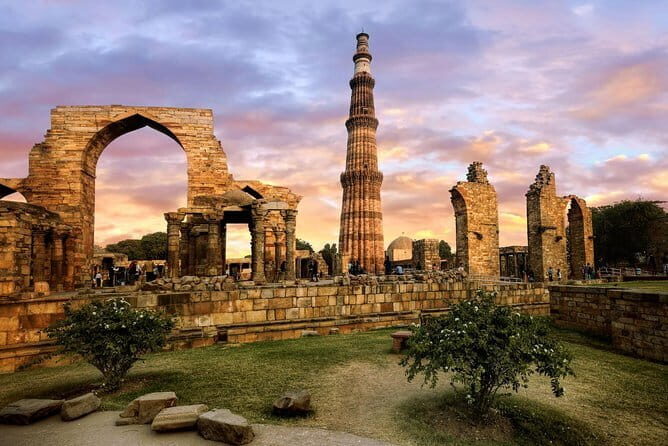
The last major stop is Qutub Minar, a 73-meter tower with five storeys and a famously tall presence in Delhi’s skyline. You’re allocated about 1 hour here, and the data notes 379 steps for the curved staircase.
Entrance is not included. So if you hate surprise expenses, you’ll want to mentally tag Qutub Minar as a ticketed stop as you plan your budget.
This is also where your trip ends on a high note. By the time you reach Qutub Minar, you’ve already traveled through Mughal grandeur and royal palaces. The tower gives you a different architectural language—still monumental, but not the same vibe as the Taj Mahal.
Price and value: where $290 really goes
The headline price is $290 per person for about 5 days. What makes that number feel fair (or not) depends on what you’d do on your own.
Here’s what’s included:
- Taxes, toll taxes, parking fees
- Driver expenses and fuel
- Breakfast for 4 days
- Pickup is offered
- You get mobile tickets
Not included:
- Personal expenses
- Driver/guide tips and optional tours
- Alcoholic/non-alcoholic beverages and mini-bar services by the hotel
- Most site entry tickets (several major ones are explicitly not included)
So, the value sweet spot is when you want someone else to handle inter-city transport, reduce your transit stress, and bundle a guided flow. If you’re traveling with a plan to self-drive and self-book entrances, you might be able to shave costs. But you’d trade that for time and logistical headache—especially with ticket lines and site timing.
Practical budgeting tip: build a separate line item for paid admissions. The tour clearly marks which sites are free and which are not, so you’re not guessing blindly.
Guides, comfort, and the kind of safety that matters
The best part of this kind of tour isn’t just the sights. It’s the people shaping the day.
From the guidance I’ve seen highlighted, Sumit and Tabul are praised for being patient and accommodating, with a focus on comfort. In a country where traffic can be intense—especially in cities like Jaipur—that matters because every delay can snowball. Good guidance helps you keep your plans intact and protects your energy.
I also appreciate that the planning feels flexible in practice. In one account, the father-son duo stepped in to arrange the necessary driver and guides across Agra, Jaipur, and Delhi when timing had gone sideways. That gives you confidence that the operator can solve problems instead of just reciting a checklist.
Getting the timing right: Friday Taj Mahal and short stop durations
Two timing realities are built into the route.
First: Taj Mahal closure on Fridays, with a swap to the next morning if needed. That means you should avoid banking on a last-minute plan that depends on a Friday Taj photo.
Second: many stops have set time blocks. Taj Mahal gets about 2 hours. Fatehpur Sikri gets 1 hour. Jantar Mantar is 30 minutes. It’s not meant to turn you into a walking scholar, but it does mean you should treat the big sights as “see and understand,” not “stay until you’re bored.”
If you’re the kind of person who wants extra time inside City Palace or wants to climb every staircase at Qutub Minar without rushing, you may need to accept that you’ll have to return later on a second trip or add optional time on your own.
Who should book this Agra-to-Delhi Golden Triangle?
This tour fits best if:
- You want a guided sweep of Agra, Jaipur, and Delhi without doing a ton of planning.
- You care about Mughal royal heritage as a connecting theme.
- You’d rather pay for structure than spend days figuring out how to chain sites efficiently.
It may not be ideal if:
- You want a slow-paced, deep-dive museum vacation.
- You hate paying multiple admissions and would rather only visit free-entry monuments.
Should you book this Golden Triangle tour from Agra?
I’d book it if you want the Golden Triangle highlights in a structured, comfortable way, especially if you appreciate guided interpretation and a plan that handles transport. The combination of major Mughal sites, royal Jaipur landmarks, and Delhi’s mix of monuments and faith spaces gives you a well-rounded first pass through North India.
If you do book, do yourself a favor: budget for entrance tickets at the stops marked as not included, and set expectations that some time blocks are short by design. With that, you’ll likely come away feeling like you used your days wisely—without turning your trip into a scheduling contest.
FAQ
What time does the tour start?
The meeting/start time is 9:30 am.
How long is the tour?
The duration is 5 days (approx.).
Is pickup included?
Yes. Pickup is offered, and this is listed as a private tour/activity for only your group.
Are admission tickets included?
No. Some sites are not included for admission tickets (including places like Agra Fort, Taj Mahal, City Palace, Humayun’s Tomb, Red Fort, and Qutub Minar). Other stops are listed as free admission.
Is breakfast included?
Yes. Breakfast is included for 4 days.
Does the tour include any free attractions?
Yes. Stops such as Fatehpur Sikri, Amer, India Gate, Gurudwara Bangla Sahib, Raj Ghat, and the Lotus Temple are listed as free admission.
What happens if my trip includes a Friday?
The Taj Mahal remains closed on Friday. If your Taj day would be Friday, it’s scheduled for the next day morning instead.
Is there free cancellation?
Yes. You can cancel up to 24 hours in advance for a full refund.