REVIEW · NEW DELHI
Golden Triangle Agra Jaipur with Lalit Private Drivers India
Book on Viator →Operated by Lalit Private Drivers India · Bookable on Viator
Golden Triangle planning gets easier with a driver. This 5-day India route pairs private logistics with a tight mix of Delhi, Agra, and Jaipur highlights, using an air-conditioned vehicle, bottled water, and onboard WiFi. I especially like the Taj Mahal sunrise timing and the fact that you also get a licensed guide to help you connect what you’re seeing, from Mughal Delhi to pink-sandstone Jaipur.
The only real drawback is pacing and budgeting: many of the biggest sites are ticketed separately (the schedule lists some free stops, but most major monuments are not). Also, the early-morning light means you should plan for an early start, and you’ll want your driver to be on schedule—this is one area where Lalit’s team is often praised by name for calm, reliable service, including people like Rohit, Pawan, Jile Choudhary, and Azad.
In This Review
- Key highlights you’ll feel on the ground
- Why a private driver turns the Golden Triangle into a smoother plan
- Delhi Day 1: Birla Mandir Temple and a calm opening to the city
- Day 2 in Delhi: India Gate, Humayun’s Tomb, Red Fort, and the Old Delhi lift
- India Gate: a war memorial with a grand urban setting
- Humayun’s Tomb: the first garden-tomb on the subcontinent
- Red Fort: Mughal power, commissioned in 1639
- Chandni Chowk: spices, silver jewelry, and side streets with constant motion
- Lotus Temple: modern, open-to-all design
- Qutb Minar: the UNESCO victory tower in South Delhi
- Jaipur Day 5 really hits: forts, palaces, and Jantar Mantar in one sweep
- Hawa Mahal: pink-red facade and the Zenana idea
- Amber Palace / Amer Fort: high on the hill, built for drama
- Jal Mahal: a palace sitting on Man Sagar Lake
- City Palace: royal residence and administrative headquarters
- Jantar Mantar: 19 astronomical instruments and the biggest stone sundial
- Agra Day 3: Taj Mahal viewing from the Yamuna and Mehtab Bagh alignment
- Agra Day 4: Taj Mahal itself plus Fatehpur Sikri
- Taj Mahal: ivory-white marble mausoleum and the two tombs
- Fatehpur Sikri: red sandstone, Buland Darwaza, and Salim Chishti
- Delhi shopping and street time: Chandni Chowk plus the rickshaw ride
- Price and logistics: is $290.46 per group good value?
- Who should book this Golden Triangle plan—and who might hesitate
- Should you book Lalit Private Drivers India’s Golden Triangle 5-day route?
- FAQ
- What is included in the Golden Triangle tour price?
- Is pickup available from New Delhi airport?
- How many people is the private group limited to?
- How long is the tour?
- Are entrance tickets included for major attractions?
- What cities does this Golden Triangle cover?
- Can I get a full refund if I cancel?
Key highlights you’ll feel on the ground

- Private car with WiFi, AC, and bottled water keeps long drives from becoming miserable
- Licensed guide included so you’re not just collecting photos—you’re learning as you go
- Taj Mahal sunrise visit plus a second Taj viewing angle helps you catch both mood and detail
- Old Delhi time for Chandni Chowk and a rickshaw ride gives you the real street-energy context
- Plenty of UNESCO-listed stops across Delhi and Jaipur (Qutb Minar, Humayun’s Tomb, Jantar Mantar)
- A one-day Jaipur lineup that hits Amber Fort, City Palace, Hawa Mahal, Jal Mahal, and Jantar Mantar
Why a private driver turns the Golden Triangle into a smoother plan
A Golden Triangle trip lives and dies by timing. On this kind of 5-day run, you’re bouncing between New Delhi, Agra, and Jaipur while traffic and crowds can scramble your day. The biggest practical win here is that you’re not doing the navigation puzzle yourself. You’re traveling in an air-conditioned vehicle with parking fee included, plus onboard WiFi and bottled water—small things that matter when you’re already juggling early starts and long sightseeing blocks.
Another big value point is the guide. A licensed guide isn’t just about reciting facts. It helps you get bearings fast: why Humayun’s Tomb matters as a first garden-tomb, how it influenced later Mughal design, and what to look for at Qutb Minar beyond the obvious height. And in a route with so many major monuments, that kind of explanation saves you from “standing in front of a building” mode.
Finally, this plan is built for a small group: up to 2 people. That usually means fewer compromises—more time waiting for tickets doesn’t turn into a negotiation inside the group. It also makes it easier to keep the day moving at a pace that fits your schedule.
You can also read our reviews of more private tours in New Delhi



Delhi Day 1: Birla Mandir Temple and a calm opening to the city
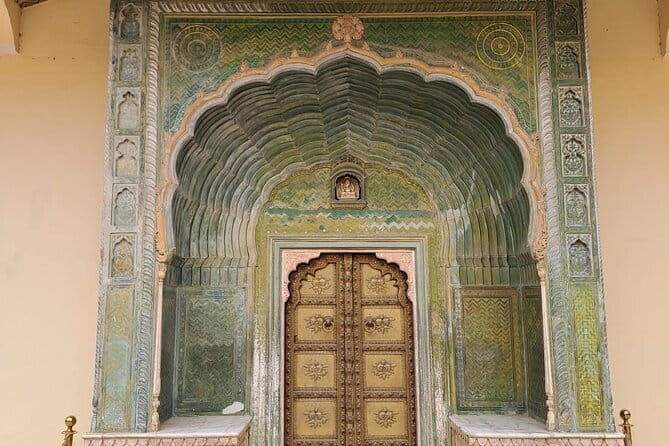
Your first day centers on Birla Mandir Temple, also known as the Lakshmi Narayan (Laxminarayan) Mandir. This is a Hindu temple in New Delhi with Laxminarayan as the presiding deity, linking Vishnu and Lakshmi. What makes this stop more than just a pretty building is the story attached to it: it was inaugurated by Mahatma Gandhi, and Gandhi made sure people from all castes could attend.
Why I like this as a start: it’s a gentler entry point into India’s spiritual architecture compared with jumping straight into the busiest Old Delhi lanes. You also get a sense of how religion, community access, and public life overlap in modern Delhi.
Time-wise, this is a short stop (about 30 minutes). That means you’re not trapped in an all-day temple schedule on your first day—ideal if you’re arriving with jet lag or just need an easy warm-up.
Day 2 in Delhi: India Gate, Humayun’s Tomb, Red Fort, and the Old Delhi lift
Day 2 is where Delhi starts to feel like Delhi. The route threads together major landmarks that sit along or near the city’s ceremonial and historical axes.
India Gate: a war memorial with a grand urban setting
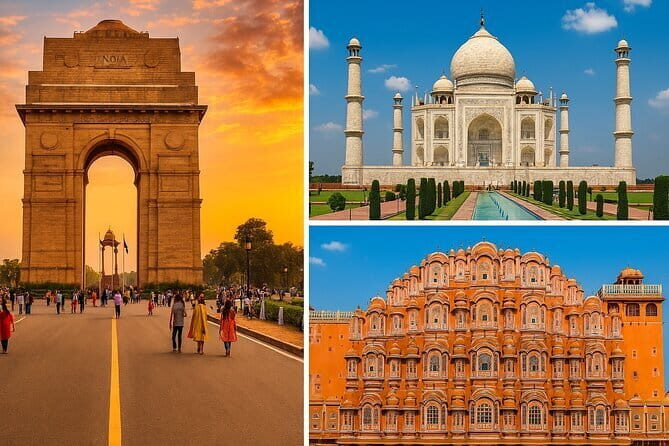
India Gate, described as the former All India War Memorial, sits near Rajpath (Kartavya path). It’s a straightforward stop in terms of “what it is,” but it’s useful because it gives you a wide-city frame. When you connect it later with Mughal power centers like Humayun’s Tomb and Red Fort, you’ll feel the shift from empire-building eras to modern nation symbolism.
Humayun’s Tomb: the first garden-tomb on the subcontinent
Humayun’s Tomb (built in 1570) is a UNESCO World Heritage Site stop and one of those monuments where the layout is the lesson. It’s noted as the first garden-tomb on the Indian subcontinent, and the data also points out that it inspired architectural innovations that culminated in the Taj Mahal. If you look at it from different angles, you’ll understand why planners would call this a template moment.
Expect about 1 hour here. And because this is a flagship site, build in patience: the place tends to draw attention for obvious reasons.






Red Fort: Mughal power, commissioned in 1639
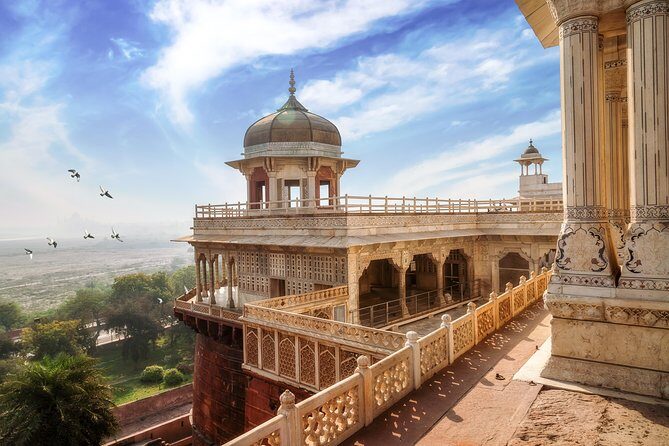
Then comes Red Fort (Lal Qila), the historic Mughal residence commissioned by Shah Jahan on 12 May 1639 when the capital shifted from Agra to Delhi. You’ll want to slow down just a bit here. A fort isn’t only walls—it’s a statement of authority and an engine for life, administration, and spectacle.
Time is tight (about 30 minutes), so I’d treat this as a “see the shape, then feel the story” stop rather than a detailed deep study.
Chandni Chowk: spices, silver jewelry, and side streets with constant motion
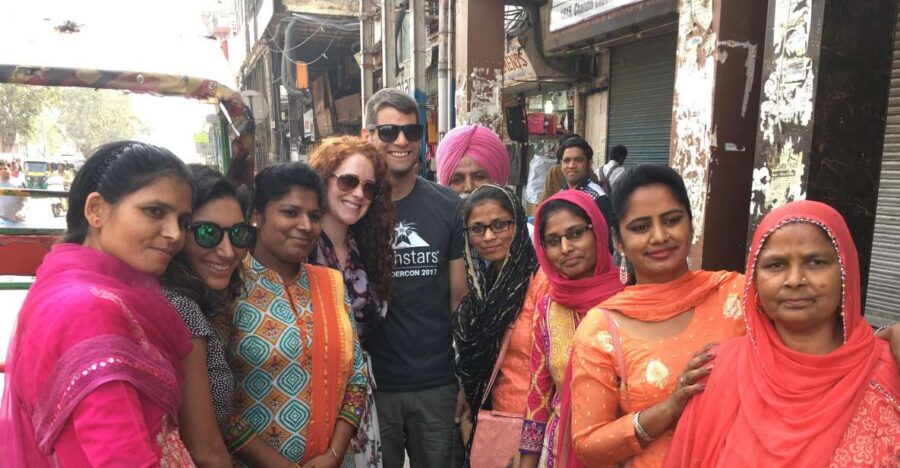
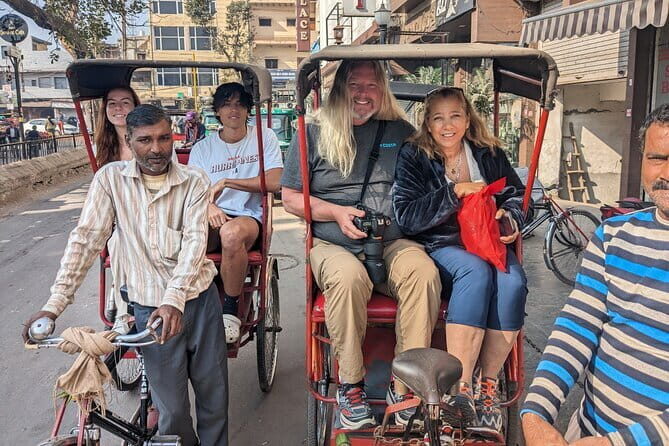
Chandni Chowk is the Old Delhi shopping heartbeat. The plan calls out the markets full of spices, dried fruit, silver jewelry, vivid saris, and even small shops selling essential oils, stationery, and traditional Indian sweets. This is also paired with a rickshaw ride, which is a fun way to experience the scale of the lanes without tiring yourself out.
The key practical point: this is described as busy and full of tight streets. If you’re someone who dislikes crowds, go slow, keep your eyes up, and hold your pace steady. If you’re fine with motion, this is one of the most “you’re really here” segments of the entire Golden Triangle.
Chandni Chowk’s time is about 1 hour, and it’s also a free stop in the schedule, which helps keep your budget balanced.
Lotus Temple: modern, open-to-all design
Lotus Temple is a Baháʼí House of Worship completed in December 1986. It’s famous for its lotus-like shape, and the big takeaway is that it’s open to all regardless of religion. The schedule lists it as about 20 minutes, and it’s free.
This works as a reset. After forts and market density, the Lotus Temple gives you a quieter, more spacious feeling—an almost natural break in the middle of a long day.
Qutb Minar: the UNESCO victory tower in South Delhi
Qutb Minar (Qutab Minar), part of the Qutb complex and tied to UNESCO, is a minaret and victory tower connected to Delhi’s oldest fortified city at Lal Kot. It’s listed as about 1 hour, with tickets not included.
This is the stop I recommend you treat like a “look up and notice the details” experience. The monument’s power is in scale, but the surrounding complex helps you understand it as part of a bigger system of early fortified Delhi.
Jaipur Day 5 really hits: forts, palaces, and Jantar Mantar in one sweep
Your final day in Jaipur stacks several “wow” buildings, so expect it to feel like a highlight reel. The good news: these aren’t just random stops. They connect by theme—power (Amber), royal life (City Palace), women’s quarters and facade design (Hawa Mahal), visual tradition and water architecture (Jal Mahal), and science-meets-design (Jantar Mantar).
Hawa Mahal: pink-red facade and the Zenana idea
Hawa Mahal (Palace of Winds) is built from red and pink sandstone and sits on the edge of the City Palace, extending to the Zenana or women’s chambers. The name comes from the idea of ventilation and window views. It’s also one of the quickest ways to understand Jaipur’s architecture as display: intricate facades made to be seen, not hidden.
The schedule doesn’t assign a set duration to Hawa Mahal by itself here, but it’s positioned as an early stop on Day 5, which makes sense for timing and light.
Amber Palace / Amer Fort: high on the hill, built for drama
Amber Fort (Amer) is about 11 kilometers from Jaipur and sits high on a hill. The schedule lists 2 hours. This is your main fort moment of the day and a top reason to choose the Golden Triangle route in the first place.
If you take one “strategy” approach here, it’s this: don’t just walk through quickly. Look for how the fort’s layout supports movement and control. Forts weren’t built for tourists—they were built for rulers, security, and display.
Jal Mahal: a palace sitting on Man Sagar Lake
Jal Mahal is described as a palace in the middle of Man Sagar Lake. It was originally constructed around 1699, and later renovated and enlarged in the early 18th century by Maharaja Jai Singh II of Amber. That gives the building a layered history rather than one single construction moment.
This stop tends to be a visual payoff. It’s also a good breather between heavier fort and palace visits.
City Palace: royal residence and administrative headquarters
City Palace is a royal residence and former administrative headquarters. Construction started soon after the establishment of Jaipur under Maharaja Sawai Jai Singh II, who moved his court to Jaipur from Amber in 1727.
The schedule lists about 1 hour. Here, I think the value is in understanding Jaipur as more than a photo set. This is where the court lived and ran things—so it links the earlier Amber power base to Jaipur’s later role.
Jantar Mantar: 19 astronomical instruments and the biggest stone sundial
Jantar Mantar is a set of 19 astronomical instruments built by Sawai Jai Singh, completed in 1734. It’s UNESCO-listed, and the schedule highlights the world’s largest stone sundial.
The best way to enjoy it is to slow down enough to see that it isn’t random decoration. It’s science and architecture fused. If you’ve ever seen people point at constellations in a museum and wondered how ancient instruments worked, this is the practical answer—built in stone.
Agra Day 3: Taj Mahal viewing from the Yamuna and Mehtab Bagh alignment

Agra gets its own “build-up day” with viewpoint time. The plan includes a Taj Mahal view point developed by Agra Development Authority near Mehtab Bagh on the bank of the Yamuna. Even without entering the main complex yet, this sets you up to understand what you’re about to see.
Then you hit Mehtab Bagh, described as a charbagh garden north of the Taj Mahal, aligned with it across the Yamuna River. The plan specifies the square layout (around 300 by 300 metres) and notes the perfect alignment opposite the Taj Mahal complex.
This is exactly why I like having Mehtab Bagh in the schedule: it gives you a different mental picture. Instead of only seeing the Taj Mahal as a single object, you start seeing it as a designed composition—garden, river, and monument working together.
It’s also a short stop (about 30 minutes). That’s good because it leaves space for the next day’s heavier Taj Mahal visit.
Agra Day 4: Taj Mahal itself plus Fatehpur Sikri
Day 4 is the “this is why you came” day.
Taj Mahal: ivory-white marble mausoleum and the two tombs
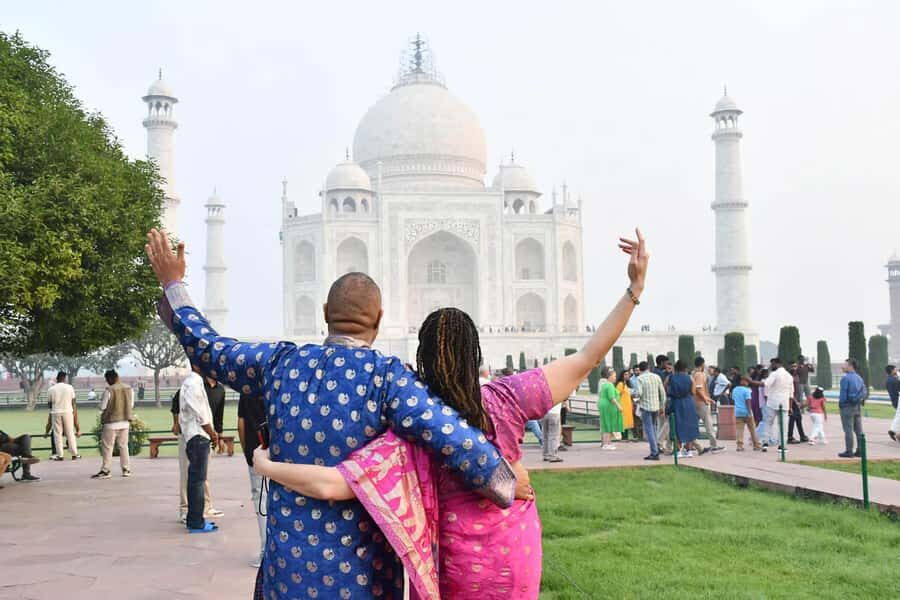
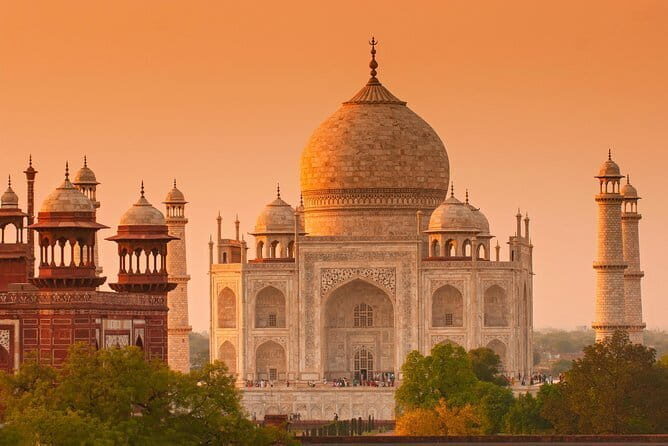
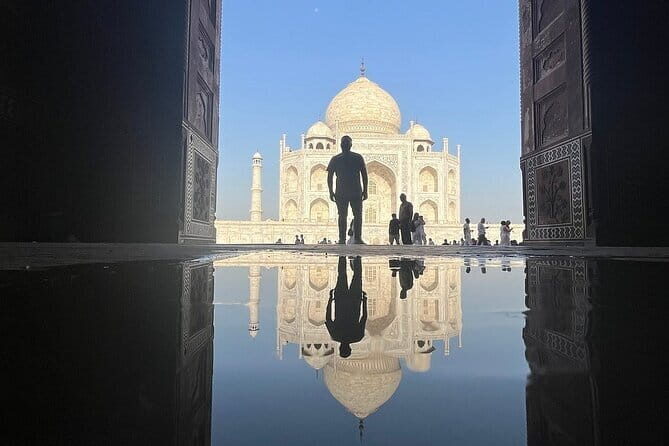
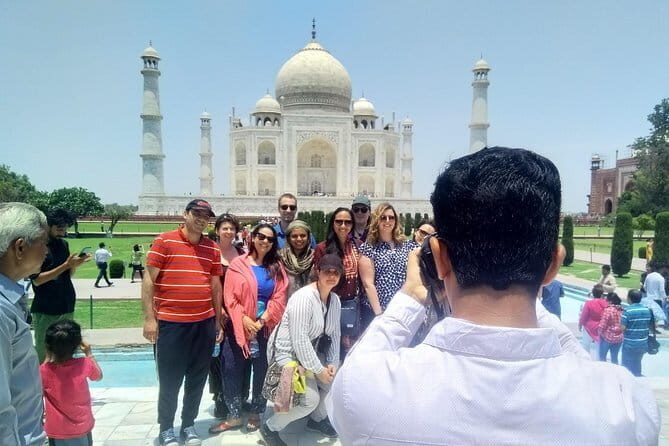
The Taj Mahal is an ivory-white marble mausoleum on the right bank of the Yamuna. It was commissioned in 1631 by Shah Jahan to house the tomb of his wife Mumtaz Mahal, and it also houses Shah Jahan’s tomb.
You get about 2 hours here. That’s enough time to see the mausoleum area without feeling like you’re racing your own feet. The trick is to manage your expectations: don’t spend all your time craning toward the main facade. Use the guide’s context to notice the building as an entire project—how it sits in its setting and how the monument’s geometry works.
Also, since the overall plan calls out a Taj Mahal sunrise visit, this route is set up around morning light. If sunrise is included in your specific booking, plan for early start energy and keep water in mind (bottled water is included for the trip).
Fatehpur Sikri: red sandstone, Buland Darwaza, and Salim Chishti
After Taj Mahal, the schedule moves to Fatehpur Sikri, described as a small city founded by a 16th-century Mughal emperor. It features red sandstone buildings clustered at its center.
A couple of the named sights are important:
- Buland Darwaza gate, entrance to the Jama Masjid mosque
- Nearby marble Tomb of Salim Chishti
This stop is about 2 hours and is listed as free in the schedule. Free doesn’t mean casual—Fatehpur Sikri is still a major cultural site—but it helps your budget.
Delhi shopping and street time: Chandni Chowk plus the rickshaw ride
The route specifically calls out a lively Old Delhi segment: Chandni Chowk, plus a rickshaw ride, plus time around markets with spices, silver jewelry, and small specialty shops. This is the part that tends to feel most immediate.
Here’s what you should consider:
- You’ll be walking in tight, crowded lanes, so wear comfortable shoes.
- Street markets can be distracting in a good way. If you want to shop, keep your time focused because the day has other fixed monuments.
- The schedule lists admission free for Chandni Chowk, which is helpful when you’re paying for other big-ticket attractions.
If you want one “souvenir strategy,” make it small and easy: choose a couple of meaningful items rather than trying to cover everything in an hour.
Price and logistics: is $290.46 per group good value?
At $290.46 per group (up to 2) for an approx 5-day private plan, the value mainly comes from what’s bundled in the day-to-day mechanics:
Included:
- arrival and departure fee
- all fees and taxes
- parking fee
- air-conditioned vehicle
- WiFi on board
- bottled water
- licensed guide
That’s the real money saver—private driving between Delhi, Agra, and Jaipur plus guided time adds up fast when you price it piece by piece. The part you should budget for separately is attractions where the schedule lists admission tickets as not included. In your route, many major monuments (like Birla Mandir, Humayun’s Tomb, Red Fort, Qutb Minar, Taj Mahal, and Amer Fort) are not included in the schedule’s admission notes, while some stops are free (like Lotus Temple, Chandni Chowk, and Fatehpur Sikri).
So the right way to judge the price is simple: if you’d otherwise have to hire a private driver and figure out guiding yourself, this plan tends to be strong value. If you’re hoping for everything to be all-in at a single fixed rate, read the ticket notes closely.
Who should book this Golden Triangle plan—and who might hesitate
This route is a strong fit if you:
- want a private Golden Triangle with minimal hassle
- enjoy structured days with a guide who explains what you’re seeing
- care about timing hits like Taj Mahal sunrise and additional viewpoint time
- want to cover a lot of iconic Delhi, Agra, and Jaipur without coordinating buses or trains
It may feel less ideal if you:
- hate early mornings (sunrise timing can mean you’ll start before you want to)
- dislike packed schedules and prefer slower, longer museum pacing
- want every single admission cost included in one total price (the schedule notes separate tickets for many key sites)
Should you book Lalit Private Drivers India’s Golden Triangle 5-day route?
I’d book it if your priority is simple: see the essentials with comfort, guidance, and planning already handled. The combination of air-conditioned private transport, onboard WiFi, bottled water, parking coverage, and a licensed guide makes the “work” of travel smaller. Add in the way the route repeats the Taj Mahal theme through both sunrise timing and viewpoint angles, and you get more payoff than a one-shot stop.
If you’re the kind of traveler who wants a relaxed pace with lots of unplanned stops, you might prefer a looser schedule. But for most people—especially those with limited time—this is a sensible, high-coverage Golden Triangle option.
FAQ
What is included in the Golden Triangle tour price?
The price includes arrival and departure fees, all fees and taxes, parking fee, WiFi on board, an air-conditioned vehicle, bottled water, and a licensed guide.
Is pickup available from New Delhi airport?
Yes. Pickup is offered, and the start point is Indira Gandhi International Airport in New Delhi.
How many people is the private group limited to?
This is a private tour/activity, and the group size is up to 2.
How long is the tour?
The duration is approximately 5 days.
Are entrance tickets included for major attractions?
Not for most sites. The schedule lists admission ticket not included for many major monuments, while some stops are free (for example Lotus Temple, Chandni Chowk, and Fatehpur Sikri).
What cities does this Golden Triangle cover?
It covers New Delhi, Agra, and Jaipur.
Can I get a full refund if I cancel?
Yes, free cancellation is available. You can cancel up to 24 hours in advance for a full refund.