REVIEW · JAIPUR
4-Nights 5-Days India’s Golden Triangle – Jaipur Agra Delhi Tour
Book on Viator →Operated by Janu Private Tours · Bookable on Viator
Golden Triangle in five days? Yes, and it’s organized. This private Jaipur-based tour strings together the big-name sights of Jaipur, Agra, and Delhi using an A/C vehicle just for your group, with hotel or airport pickup and drop-off built in. You’ll also get bottled water along the way, which sounds small until you’re moving through heat and crowds.
What I like most is having a guide who helps you make sense of what you’re seeing, not just point and go. I also love the “less friction” approach: professional help, chauffeur driving, and a schedule that hits the core highlights without making you hunt for tickets and directions.
The main drawback is that the day-to-day pace is busy, and most monument entry fees are not included. Add in a moderate amount of walking (and dress rules for religious sites), and you’ll want comfortable shoes and a plan for extra costs.
In This Review
- Key highlights at a glance
- Golden Triangle Fast-Track: why this 5-day route works
- Jaipur: Hawa Mahal, City Palace, Jantar Mantar, and Jal Mahal
- Practical note on Jaipur walking
- Abhaneri step wells and the Chand Baori moment
- Agra: Fatehpur Sikri, Mehtab Bagh, Itimad-ud-Daulah, Agra Fort, and the Taj
- Taj Mahal: plan for the timing and dress rules
- Delhi: Qutub Minar, Humayun’s Tomb, Jama Masjid, and Red Fort
- Getting around: private A/C transport, bottled water, and the comfort factor
- Price and value: what $340 covers, and what you should budget extra
- A smart way to think about it
- Who should book this Golden Triangle tour?
- Should you book this 4-nights 5-days Golden Triangle tour?
- FAQ
- How long is the tour?
- Does the tour include pickup and drop-off?
- Is transportation private and air-conditioned?
- What’s included in the price?
- What isn’t included?
- Are there entrance fees for every stop?
- Is the Taj Mahal always open?
- What should I wear for temple or religious sites?
- Is a passport required?
Key highlights at a glance
- Private A/C vehicle with pickup and drop-off across Jaipur, Agra, and Delhi
- Professional guides for major monuments, focused on what matters at each stop
- Taj Mahal timing support, with an early-morning style visit and Friday closure noted
- Historic details that add context, like why Hawa Mahal’s latticework was designed
- Strong Agra day mix, including Fort, the Taj area, and Mehtab Bagh sunset viewing
- Free entry stops in the mix, including Abhaneri (Chand Baori/Harshat Mata Temple) and Fatehpur Sikri
Golden Triangle Fast-Track: why this 5-day route works
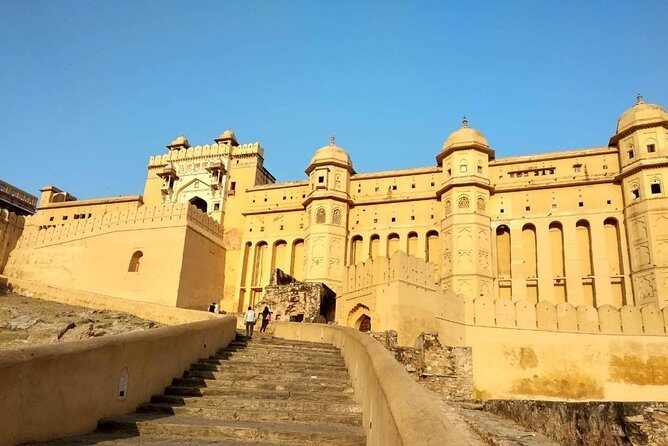
If this is your first time to North India, the Golden Triangle is the shortcut to big, unforgettable sights. The trick is doing it in a way that doesn’t turn into stress math. This tour leans hard into the practical stuff: private transport, guide time in each city, and a sequence that keeps you from backtracking too much.
You’ll spend your days bouncing between three very different atmospheres. Jaipur feels like color and stonework, Agra is all about Mughal scale and symmetry, and Delhi mixes monumental history with modern city movement. With a chauffeur-driven A/C vehicle and bottled water included, your energy stays focused on the sights, not the logistics.
You can also read our reviews of more tours and experiences in Jaipur.


Jaipur: Hawa Mahal, City Palace, Jantar Mantar, and Jal Mahal
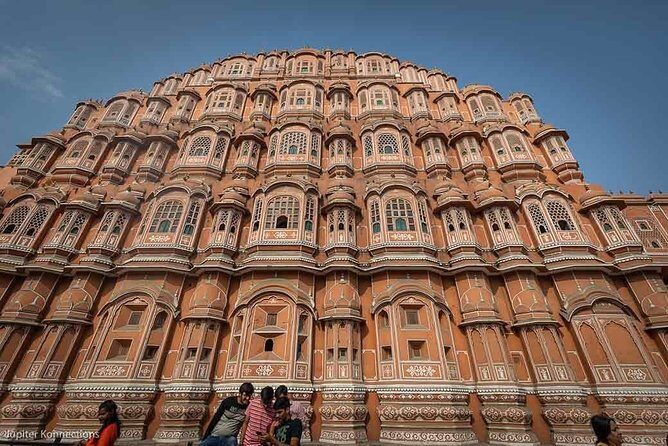
Your Jaipur time starts with one of the city’s most recognizable faces: Hawa Mahal, the Palace of Wind. The key detail here is the purpose. It was planned for the royal household to view street life while allowing citizens access too. Up close, the curved latticework arches create a repeating pattern that looks almost like honeycomb when the light hits it.
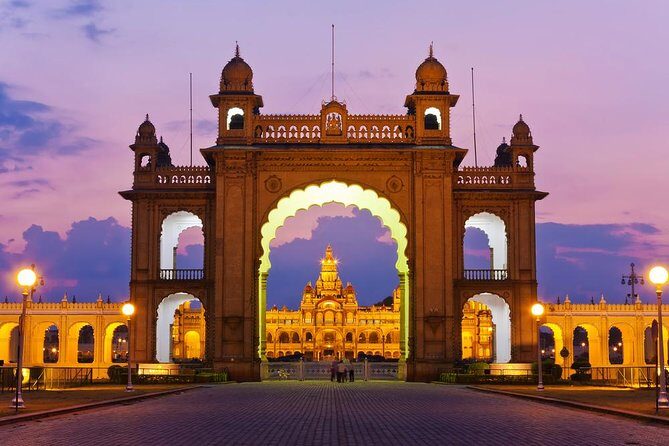
Next comes City Palace, a spread-out complex with separated courtyards and garden spaces. This is where Jaipur’s layout becomes easier to understand. Instead of one single building, you get zones that show how royalty organized space, views, and movement. It’s a good stop if you like architecture that changes as you move.
Then you’ll hit Jantar Mantar, a UNESCO World Heritage site and the home of the largest stone sundial in the world. What makes it more than a photo stop is that it was designed for real observation. The structures helped with astronomical calculations, and the site is still referenced as an observatory today. If you like science history, you’ll probably enjoy how geometric and deliberate everything feels.
From there, you shift to something quieter: Jal Mahal, the Water Palace in Man Sagar Lake. Even though it’s an easy “wow” photo, it’s also a story about rebuilding. The palace and surrounding lake area were renovated and enlarged in the 18th century by Maharaja Jai Singh II of Amber, and the structure is known for its five-story red sandstone look.
Practical note on Jaipur walking
This city leg includes multiple monument zones, so expect some walking between viewpoints and entrances. The good news is that breaks are built in through the stop durations, and your A/C vehicle helps you cool down between sites.
Abhaneri step wells and the Chand Baori moment
One of the best “less common” stops on the route is Abhaneri, best known for its step wells—especially Chand Baori—and the nearby Harshat Mata Temple area. These step wells are a distinctly Indian solution to heat: large tanks and descending steps used as cool places and water storage.
What I find compelling is that it isn’t just a structure. It’s a ritual space too. The site notes a traditional pattern of washing hands and feet before temple visits, which adds a human layer beyond the architecture. You’ll also learn how the name evolved over time, with Abhaneri tied to the earlier term linked to brightness.
Admission for Abhaneri on this route is listed as free, which is a nice value add when you’re already paying for transport and guides.
Agra: Fatehpur Sikri, Mehtab Bagh, Itimad-ud-Daulah, Agra Fort, and the Taj
Agra is where the route turns from “many landmarks” into “one monumental target.” But you don’t go straight to the Taj and call it done. You’ll also see Fatehpur Sikri, a fortified ancient city about 40 km west of Agra and once the short-lived Mughal capital under Emperor Akbar. The standout idea here is planning. It’s described as a first planned Mughal city and an early example of Mughal architecture blending Indian, Persian, and Islamic styles. UNESCO status since 1986 is part of why it’s protected and preserved for visitors.
Admission for Fatehpur Sikri on this route is listed as free, which can help offset the fact that most other monument entries are not included.
Then you get one of the Taj area’s best pacing tools: Mehtab Bagh, the Moonlight Garden. It’s designed along the Yamuna River, and it’s described as part of a larger set of gardens started by Emperor Babur. The practical value is what you came for: a calmer view of the Taj Mahal from across the river. If the Taj looks better with your eyes relaxed and your mind not racing, this stop helps you do exactly that at sunset.
Next up is Tomb of I’timād-ud-Daulah, often called the Baby Taj or treated like a draft version of the Taj Mahal. This is a smart move in a multi-day plan because it gives you an earlier look at the “jewel box” feeling—intricate stonework and a refined Mughal mausoleum style—before the full Taj impact.
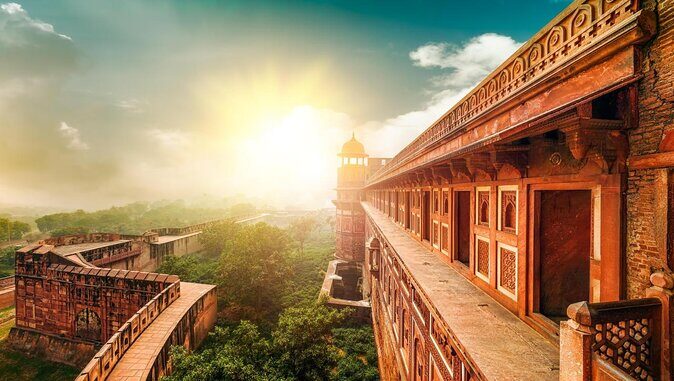
After that, Agra Fort brings you back to scale and power. It’s a massive red sandstone fort tied to Mughal rule under Akbar, with notable halls like Diwan-i-Aam and Diwan-i-Khas spaces, plus areas such as the Pearl Mosque and Musamman Burj. The story detail that hits hard here is that Aurangzeb imprisoned his father, Shah Jahan, at this site. Even if you’re not a hardcore Mughal history fan, the fort context makes the Taj feel less like a standalone artwork and more like a symbol inside a larger imperial world.






Taj Mahal: plan for the timing and dress rules
The Taj Mahal stop is built around an early-morning style visit, described as relative quiet with soft morning glow and changing marble tones as shadows and sunrise shift the color from pale grey and yellow into pearly cream and white. That timing matters because it’s when you’ll get the best balance of light and fewer crowds.
Two key reminders from the tour info:
- The Taj Mahal is closed every Friday, so your day must avoid that.
- Dress code is smart casual, and for temple-related visits, short shorts or sleeveless tops are not recommended. Even at the Taj, you should expect visitors to follow respectful clothing norms.
The Taj Mahal listed duration is 3 hours. That’s enough time to see it in multiple angles without rushing through every corner.
Delhi: Qutub Minar, Humayun’s Tomb, Jama Masjid, and Red Fort
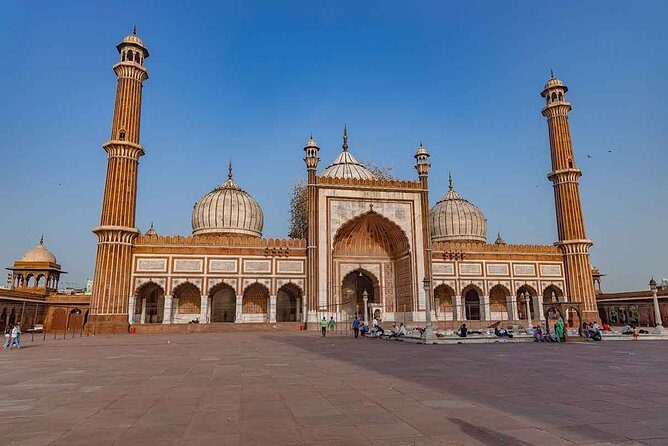
After Jaipur and Agra, Delhi can feel like a different planet: bigger roads, more traffic pressure, more layers of modern city life. The tour still keeps the focus on top monuments you can’t easily replace with a DIY day.
Start with Qutub Minar, a UNESCO-listed complex and a 73-meter brick minaret. It’s framed as a tower of victory, built after the defeat of Delhi’s last Hindu kingdom. That context helps you read the minaret as a marker of power and change, not just a tall structure.
Then you’ll visit Humayun’s Tomb. This one matters because it’s described as the first garden tomb in Asia. The point isn’t only that it’s pretty. It shows how Mughal funerary design used gardens to create a controlled experience of space and symmetry. The tour info also names the people behind the design: commissioned by Humayun’s first wife and chief consort Empress Bega Begum, with design credited to Persian architects Mirak Mirza Ghiyas and his son, Sayyid Muhammad.
Jama Masjid is next, one of the largest mosques in India and an example of Mughal architecture. It’s often easier to appreciate when you understand the size first, then look for the details second. Plan for a little time to absorb the scale and the interior approach.
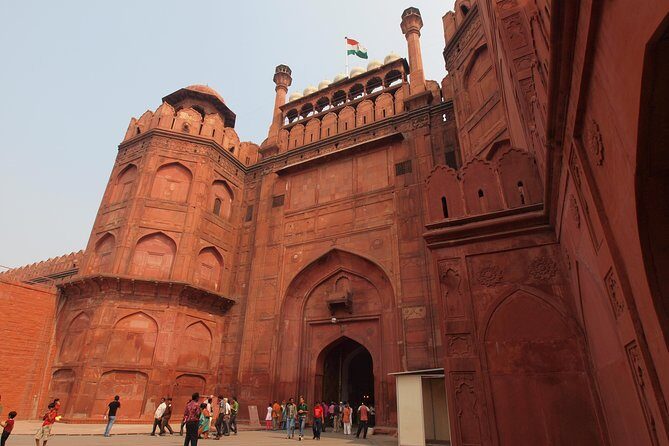
Finally, the Red Fort brings the Old Delhi Mughal-era story back to stone. It’s a Mughal fort built in the mid-17th century by Shah Jahan and designated as UNESCO. The fort is linked to the idea of imperial presence in everyday life: ceremonial spaces, admin spaces, and the theatrical side of monarchy all in one enclosure.
Getting around: private A/C transport, bottled water, and the comfort factor
One reason the Golden Triangle can feel exhausting is transit. This tour handles that with a chauffeur-driven A/C private vehicle and round-trip pickup from your hotel, airport, or railway station. That detail matters for first-timers because you avoid the extra stress of figuring out how to reach city centers with luggage, late arrivals, or jet lag.
The A/C isn’t a luxury when you’re doing full days in hot sun. Bottled water is included too, and you’ll be glad it’s there when you’re walking through forts, climbing stair zones, or waiting for the right light for photos.
Also, it’s built as a private tour. Your group only participates, so your pace and stops should feel more adjustable than a large bus tour. The tradeoff is that you’ll still be moving a lot, and flexibility can depend on timing and monument entry rules.
Price and value: what $340 covers, and what you should budget extra
At $340 per person for 4 nights and 5 days, you’re paying mainly for three things: the private chauffeur-driven A/C vehicle, the professional guides covering the Jaipur/Agra/Delhi monument days, and the convenience of pickup and drop-off. That’s the core value if you want to see a lot without constantly negotiating transit and directions.
The items not included are important to plan for:
- Accommodation
- Meals and other personal expenses
- Monument entrance fees and camera fees
- Tips for driver and guide
Because most stops list admission tickets as not included, your final spending will depend on entry fees and any optional photo charges. You do get two free-entry highlights on the route: Abhaneri and Fatehpur Sikri. That helps, but you should still assume you’ll pay for entries at big names like Hawa Mahal, City Palace, Jantar Mantar, Mehtab Bagh, the mausoleums and forts, and the major Delhi monuments.
A smart way to think about it
If you were to pay for private car hire, a skilled guide, and intercity timing yourself, the bundled price starts to look more reasonable. If you travel with a tight budget and want to spend minimal on guides and transport, you might compare against independent planning. But if your priority is smooth days and clear explanations, this price-to-convenience ratio tends to make sense.
Who should book this Golden Triangle tour?
This tour fits best if you:
- Want to cover Jaipur, Agra, and Delhi in one focused pass
- Prefer private transport and guided monument time
- Like learning the context behind architecture and imperial sites
- Want someone handling route flow and timing so you can focus on the sights
It may be less ideal if you:
- Hate packed schedules or long days
- Want zero extra costs on top of the base price
- Need fully flexible start times every day (your timing still depends on monument operations and traffic)
Should you book this 4-nights 5-days Golden Triangle tour?
I’d recommend booking if your main goal is to see the Golden Triangle highlights with less hassle. The strongest case is the combination of private A/C transport, hotel or airport pickup and drop-off, and professional guide time across all three cities. That’s what turns a tough route into a manageable one.
Before you commit, do two things:
- Budget for monument entry fees and a few meal stops since they are not included.
- Prepare for the dress code and walking days. Bring comfortable shoes and plan for smart casual clothing.
If you want a clean, guided path through Jaipur’s palace-and-geometry world, Agra’s Mughal masterpieces, and Delhi’s major UNESCO sites, this tour is a solid way to do it.
FAQ
How long is the tour?
It runs about 5 days with 4 nights.
Does the tour include pickup and drop-off?
Yes. Pickup and drop-off are included from your hotel, airport, or railway station.
Is transportation private and air-conditioned?
Yes. You travel in a chauffeur-driven A/C private vehicle for sightseeing.
What’s included in the price?
Included items are hotel/airport/railway station pickup and drop, a private chauffeur-driven A/C vehicle, professional tour guides for Delhi, Agra, and Jaipur monuments, and bottled water.
What isn’t included?
Accommodation, personal meals and other activity expenses, monument entrance fees/camera fees, and tips for the driver and guide are not included.
Are there entrance fees for every stop?
Many stops note that admission tickets are not included, but Abhaneri and Fatehpur Sikri are listed as free.
Is the Taj Mahal always open?
No. The Taj Mahal is closed every Friday, so your schedule must avoid that day.
What should I wear for temple or religious sites?
The dress code is smart casual. Short shorts or sleeveless tops are not recommended in temple settings.
Is a passport required?
Yes. A current valid passport is required on the day of travel for all participants.