REVIEW · MATHURA
Same Day Mathura and Vrindavan Tour From Delhi Or Agra
Book on GetYourGuide →Operated by Orhan Tour · Bookable on GetYourGuide
A day trip to Krishna country feels like a fast passport stamp. You get a tight, 12-hour route that hits Mathura first (Janmabhoomi, Dwarkadhish Temple, and Vishram Ghat) and then continues to Vrindavan for some of the most visited devotional stops, including Banke Bihari, ISKCON, and Prem Mandir. Two things I really like here are that you’re not just hopping between temples—you’re also getting context from a live guide—and that the transport is handled by a private AC car with pickup and drop-off. One thing to think about: temple areas often include donation requests and on-the-spot extras, and at least one past customer reported feeling a bit pressured about money.
You’ll typically start early, ride in comfort, and spend your day moving between sacred sites that are meaningful for different reasons—birthplace legends in Mathura, daily devotion in Vrindavan, and that Yamuna river calm at Vishram Ghat. Also, you’ll see a mix of older temples plus a very modern, white-marble highlight in Prem Mandir, which is a good contrast if you like both tradition and spectacle in the same day.
In This Review
- Key things to know before you go
- Mathura first: Janmabhoomi, Dwarkadhish, and a Yamuna pause
- Getting to Mathura from Delhi (and why the timing helps)
- Getting to Mathura from Agra (the shorter hop)
- Shri Krishna Janmabhoomi Temple: birthplace devotion in a compact complex
- Dwarkadhish Temple: architecture plus live devotion
- Vishram Ghat: a story-driven break by the Yamuna
- Vrindavan in motion: Banke Bihari, ISKCON, and Prem Mandir
- Banke Bihari Temple: a stop that runs on devotion
- ISKCON Temple: Krishna Balaram Mandir with chanting and international visitors
- Prem Mandir: modern white marble and an evening light show
- Optional extras: Radha Raman Temple and Nidhivan (if you want more)
- Lunch strategy: what you’re doing when you pause
- Getting around: the private AC car that keeps this day realistic
- Guides and languages: making temple stops make sense
- Who this tour is best for (and who should reconsider)
- Price and value: what $49 buys you on a same-day schedule
- A quick reality check: what a long 12 hours feels like
- Should you book this Same Day Mathura and Vrindavan Tour?
- FAQ
- How long is the Mathura and Vrindavan tour?
- Where are the pickup points?
- How far is the drive from Delhi or Agra to Mathura?
- Which temples are included in the main itinerary?
- Are Radha Raman Temple and Nidhivan included?
- Is lunch included?
- Are entry tickets included?
- What’s included in the tour price?
- What languages are available for the guide?
- What is the cancellation policy?
Key things to know before you go
- Private AC transport with hotel pickup and drop-off from Delhi or Agra keeps the day from turning into a bus-stand scavenger hunt.
- Janmabhoomi + Dwarkadhish give you two major Mathura anchors tied directly to Krishna devotion.
- Vishram Ghat on the Yamuna is the breather moment in the schedule, right where the story says Krishna rested after defeating Kansa.
- Vrindavan temples are the main event: Banke Bihari, ISKCON, and Prem Mandir cover big-name devotion plus a dramatic evening light show.
- Optional add-ons (Radha Raman Temple and Nidhivan) let you tailor the day if you want more than the core stops.
- A guide named Harsh has been praised for making temple stops easier to understand and for being easy to get along with.
Mathura first: Janmabhoomi, Dwarkadhish, and a Yamuna pause
This tour is built around a simple idea: see Krishna’s story in the places people attach their faith to. You start in Mathura, which is the spiritual “root” city for a lot of Krishna worship. The drive timing matters because you’re cramming a lot into one day, so early departures help you hit key sites while the day is still manageable.
You can also read our reviews of more tours and experiences in Mathura.


Getting to Mathura from Delhi (and why the timing helps)
If you’re starting from Delhi, pickup is early morning, usually from your hotel or residence. The drive is about 3–4 hours (around 145 km). That early start is not just about getting there—it helps you avoid the worst crush periods at popular temples. It also gives you more daylight time for the later Vrindavan stops.
Getting to Mathura from Agra (the shorter hop)
From Agra, pickup is from your hotel and the drive is about 1–1.5 hours (around 60 km). This is one of the quiet advantages of choosing Agra: you spend more time sightseeing and less time in transit.
Shri Krishna Janmabhoomi Temple: birthplace devotion in a compact complex
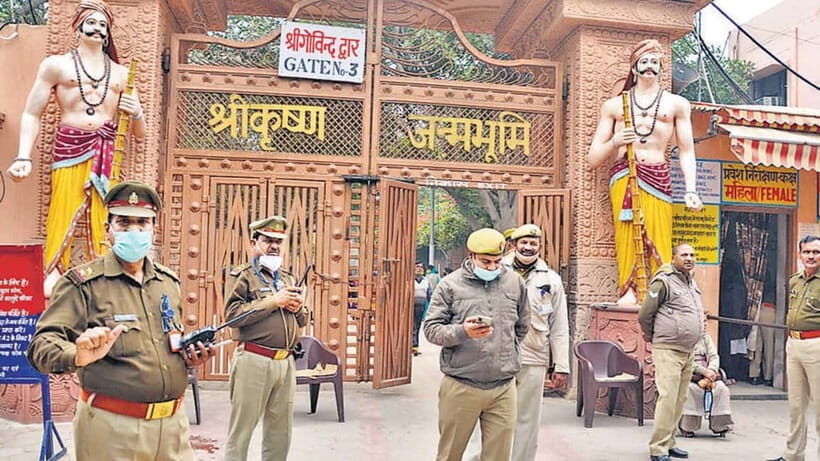
Your Mathura morning begins at Shri Krishna Janmabhoomi Temple, the site believed to be Krishna’s birthplace. What makes this stop feel different from a generic temple visit is how the complex includes multiple shrines and even a small room presented as a birthplace reference (often described as jail-like in setup). If you like pilgrimage sites that connect legend to physical space, this is one of the strongest anchors on the route.
Practical tip: dress respectfully and expect to move through crowded areas. If you want great photos, aim for calmer angles and avoid blocking worshippers. In places like this, “best shot” can mean “best patience.”
Dwarkadhish Temple: architecture plus live devotion
Next up is Dwarkadhish Temple, one of the most important Krishna temples in Mathura. You’ll spend time admiring the architecture and soaking up the devotional atmosphere. This temple works well as a change of pace after Janmabhoomi because it’s less about one birthplace moment and more about ongoing worship.
Value for your brain: a guide helps you notice what you might otherwise miss—how different shrines and spaces fit into Krishna devotion. One past customer specifically praised a guide named Harsh for giving helpful information and local context.

Vishram Ghat: a story-driven break by the Yamuna
Then you get Vishram Ghat on the banks of the Yamuna River. The story attached here is that Krishna rested after defeating the evil king Kansa. Even if you’re not chasing every legend, the ghat itself gives you a calm moment that can reset the day.
I like this stop for practical reasons, too. It’s the easiest place in the schedule to pause, look at the river, and stop feeling like you’re sprinting temple-to-temple.
Vrindavan in motion: Banke Bihari, ISKCON, and Prem Mandir
After Mathura, you drive to Vrindavan, the “temple city” where Krishna devotion shows up in songs, chanting, and nonstop pilgrim energy. This part of the day is usually where people either fall in love with the experience—or feel the schedule pressure. It’s a lot, but the payoff is that these are major, high-impact sites.
Banke Bihari Temple: a stop that runs on devotion
Banke Bihari Temple is one of the best-known Vrindavan stops and it draws constant devotees. The point here isn’t to treat it like a museum. You’re coming to witness faith in action: chanting, worship, and that feeling of being surrounded by people who came for this moment.
If you’re sensitive to crowds, I’d keep your expectations realistic. This is not the quietest temple on earth. But if you can handle bustle, you’ll probably understand why people return year after year.
ISKCON Temple: Krishna Balaram Mandir with chanting and international visitors
Next is the ISKCON Temple, also known as Krishna Balaram Mandir. This is where you’ll notice a different style of devotion—one with chanting that can feel more structured, and with international devotees visiting as well. The atmosphere tends to be serene compared with some other stops, and the idols plus chanting create an easy-to-follow flow.
If you’re traveling solo or you’re the type who likes to ask questions, this is a good place to lean on your guide for context—especially since the tour includes a live guide in multiple languages.
Prem Mandir: modern white marble and an evening light show
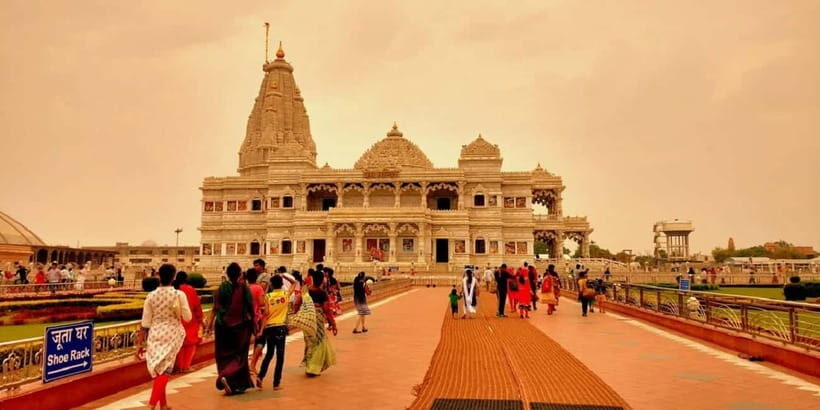
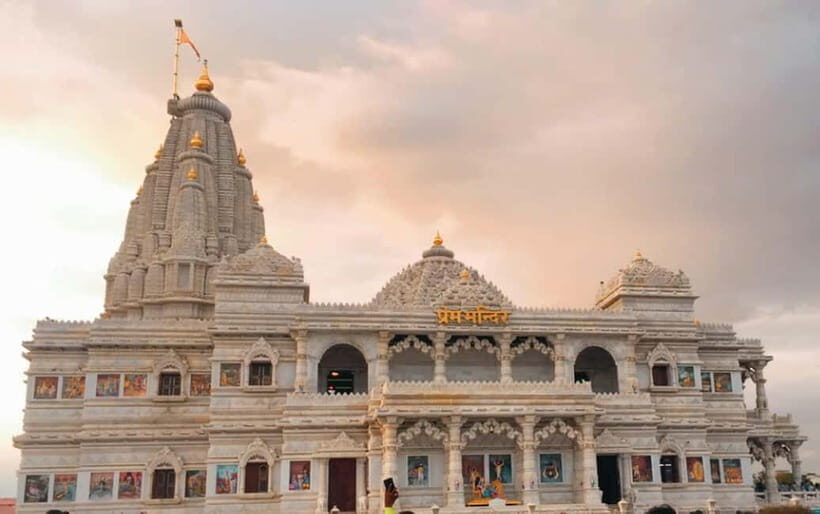
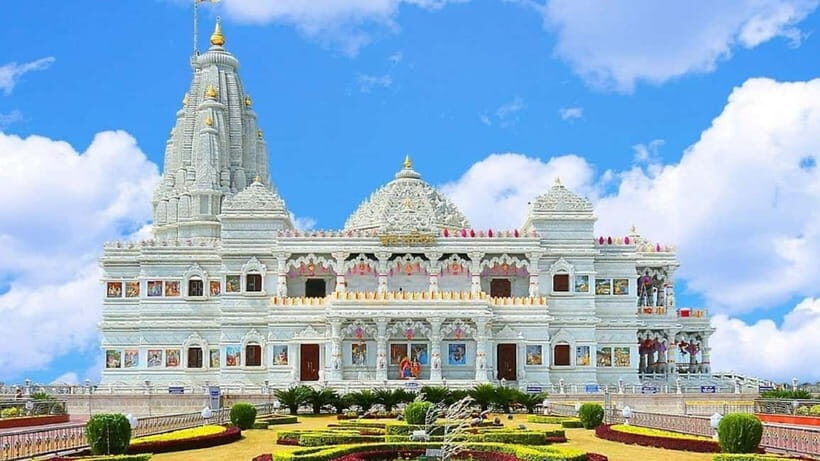
Then comes a very recognizable Vrindavan highlight: Prem Mandir, built with white marble and dedicated to Krishna and Radha. The architecture and carvings are often what people remember, and the day can include an evening light show here, depending on timing.
For value, this stop is smart because it gives you visual payoff when you might be tired of religious buildings. It’s still spiritual, but it’s also designed for the eyes.
Optional extras: Radha Raman Temple and Nidhivan (if you want more)
If you opt for additional time, you can add:
- Radha Raman Temple: an ancient-style temple with a peaceful ambiance.
- Nidhivan: a sacred forest area where it’s believed Krishna performs Ras Leela with Radha and the gopis every night.
These extras are best for people who want deeper variety beyond the headline temples. If you’re already feeling temple fatigue, you may prefer sticking to the core itinerary and saving your energy.
Lunch strategy: what you’re doing when you pause
After the morning temple circuit, there’s a break for traditional vegetarian lunch at a local restaurant in Mathura or Vrindavan. Lunch isn’t included, but the tour does include the break period as part of the day.
My advice: treat lunch like your reset button. Plan to eat earlier rather than later, and keep a little time buffer in your head, because temple timing can be unpredictable. Also, since entry tickets and lunch are not included, it helps to set a small daily cash or card budget so the day stays stress-free.
Getting around: the private AC car that keeps this day realistic
This tour includes a private AC car for sightseeing, plus pickup and drop-off, toll taxes and parking, and a mineral water bottle. That matters because a same-day tour lives or dies on logistics.
With a private setup, you avoid the coordination problems that can come with mixed groups. You’re also less likely to lose time hunting for the right entrance, especially since the tour offers skip-the-ticket-line support.
One note: entry tickets are not included. So “skip the line” usually means you reduce waiting time, not that the sites are free. You’ll still want to factor in ticket costs and be ready to pay on the ground.
Guides and languages: making temple stops make sense
A big part of why this tour works is the live guide. The tour lists English, French, German, Russian, and Spanish options, which is helpful if you don’t want to rely on hand-signs and guesses.
And yes, guide quality can swing the experience. One praised review singled out a guide named Harsh for sharing valuable temple information and being easy to get along with. On the other side of the scale, one review mentioned feeling uncomfortable because it seemed like the guide or situation pushed for money. My takeaway: have a clear idea of your comfort level with donations and any optional spending. If you’re direct, you’ll steer the day the way you want it.
Who this tour is best for (and who should reconsider)
This is a good fit if you want a fast, focused spiritual day without the hassle of planning transit between Mathura and Vrindavan.
It’s especially suitable for:
- People with limited time who still want major Krishna sites
- First-timers who benefit from a guide explaining what you’re seeing
- Anyone starting from Agra who wants maximum sightseeing time with minimum travel
You might reconsider if:
- You strongly prefer quiet, low-crowd sites (some stops attract constant crowds)
- You’re very sensitive to requests for donations or side spending
- You have mobility needs, because the listing includes both “wheelchair accessible” and a note that it’s not suitable for people with mobility impairments. If that applies to you, confirm details with the operator before booking.
Price and value: what $49 buys you on a same-day schedule
At about $49 per person for a 12-hour day, the value is mainly in the bundled logistics: private AC car, pickup/drop-off, guide, tolls, parking, and water. In a region where transit time can eat your day, that package is worth something.
What’s not included matters:
- Entry tickets are extra.
- Lunch is extra.
- Any personal expenses are extra.
So the real cost depends on your site entry fees and meal choices. Still, if you’ve ever tried to stitch together Mathura and Vrindavan yourself for a same-day plan, you know why tours like this exist: the routing and timing are the headache, and you’re paying to avoid it.
A quick reality check: what a long 12 hours feels like
This is a day trip, not a slow pilgrimage. Expect long drives and a schedule with multiple temple stops. You’ll likely move in and out of crowds several times. That’s normal here, not a failure of the tour.
The best way to enjoy it is to treat the day like a guided reading of Krishna’s geography: Mathura as the birthplace and major temple anchor, Vishram Ghat as the reflective pause, Vrindavan as devotion in daily motion.
If you go in expecting “one perfect temple” you might feel rushed. If you go in expecting a full devotional route, you’ll probably feel satisfied.
Should you book this Same Day Mathura and Vrindavan Tour?
Book it if you want a structured, first-timer-friendly day that covers the biggest Krishna landmarks in Mathura and Vrindavan with private transport and a live guide. The included car, pickup/drop-off, and skip-the-ticket-line support are practical wins.
I’d hold off or ask extra questions if you’re worried about crowds, donation pressure, or your mobility needs—because both comfort and accessibility notes in the listing suggest it’s worth confirming fit. Also, if you’re the type who hates any surprise costs, plan your budget for entry tickets and lunch up front.
If your goal is a meaningful Krishna-focused day without planning stress, this is the kind of tour that can deliver exactly that—so long as you set your expectations for a packed schedule and control your spending comfort level.
FAQ
How long is the Mathura and Vrindavan tour?
It’s listed as a 12-hour tour.
Where are the pickup points?
From Delhi, pickup is from your hotel or residence. From Agra, pickup is from your hotel.
How far is the drive from Delhi or Agra to Mathura?
From Delhi, it’s about 3–4 hours (around 145 km). From Agra, it’s about 1–1.5 hours (around 60 km).
Which temples are included in the main itinerary?
The core stops include Shri Krishna Janmabhoomi Temple, Dwarkadhish Temple, Vishram Ghat, Banke Bihari Temple, ISKCON Temple (Krishna Balaram Mandir), and Prem Mandir.
Are Radha Raman Temple and Nidhivan included?
They are listed as optional additional visits.
Is lunch included?
No. Lunch is not included, though there is a lunch break for a vegetarian meal at a local restaurant.
Are entry tickets included?
No. Entry tickets are not included.
What’s included in the tour price?
It includes a private AC car for sightseeing, pickup and drop-off, a knowledgeable live guide, all toll taxes and parking, and a mineral water bottle.
What languages are available for the guide?
The guide is available in English, French, German, Russian, and Spanish.
What is the cancellation policy?
Free cancellation is available up to 24 hours in advance for a full refund.